For many adults and couples, beginning counselling feels like a brave first step. You sit across from a therapist, you talk, you reflect, you try to understand patterns.
And often, talking helps.
But sometimes, it doesn’t feel like enough.
You may find yourself saying:
- “I understand what’s happening… but I still feel stuck.”
- “We keep having the same arguments.”
- “I don’t know why I react the way I do.”
- “Is this stress, trauma, personality differences… or something else?”
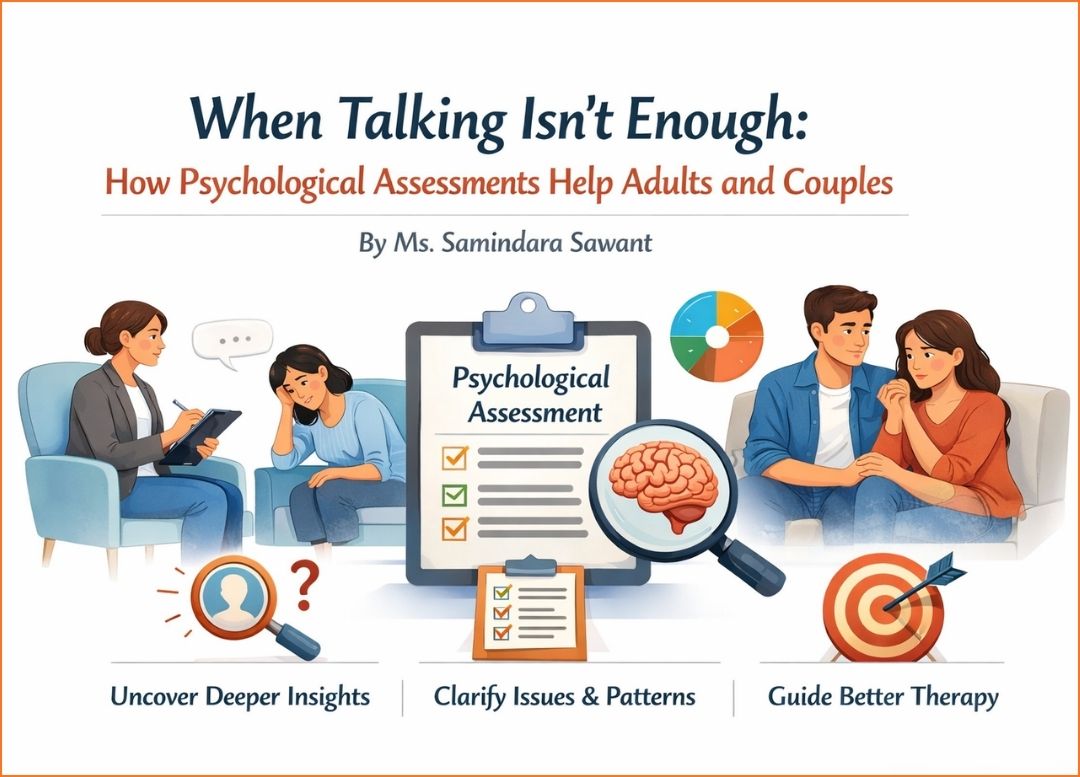
This is where psychological assessments can bring clarity, structure, and direction to the healing process.
At Disha Counselling Centre, we have been integrating psychological assessments into our counselling work with adults and couples for over two decades. Over the years, we have seen how assessments—when used ethically and appropriately—can transform not just therapy, but a person’s overall wellness journey.
Assessment vs Therapy: Understanding the Difference
One of the most common misconceptions I encounter in my practice is the belief that therapy and assessment are the same thing.
They are not.
Therapy (Counselling)
Therapy is a conversational and relational process. It focuses on:
- Emotional processing
- Behavioural change
- Coping strategies
- Improving communication
- Building insight
It is dynamic, reflective, and ongoing.
Psychological Assessment
A psychological assessment is a structured, scientific process designed to:
- Measure specific psychological traits or concerns
- Identify underlying patterns
- Clarify diagnoses (when needed)
- Provide objective data
- Guide treatment planning
Assessment uses clinically validated tools that have been researched, standardized, and approved for professional use.
In simple terms:
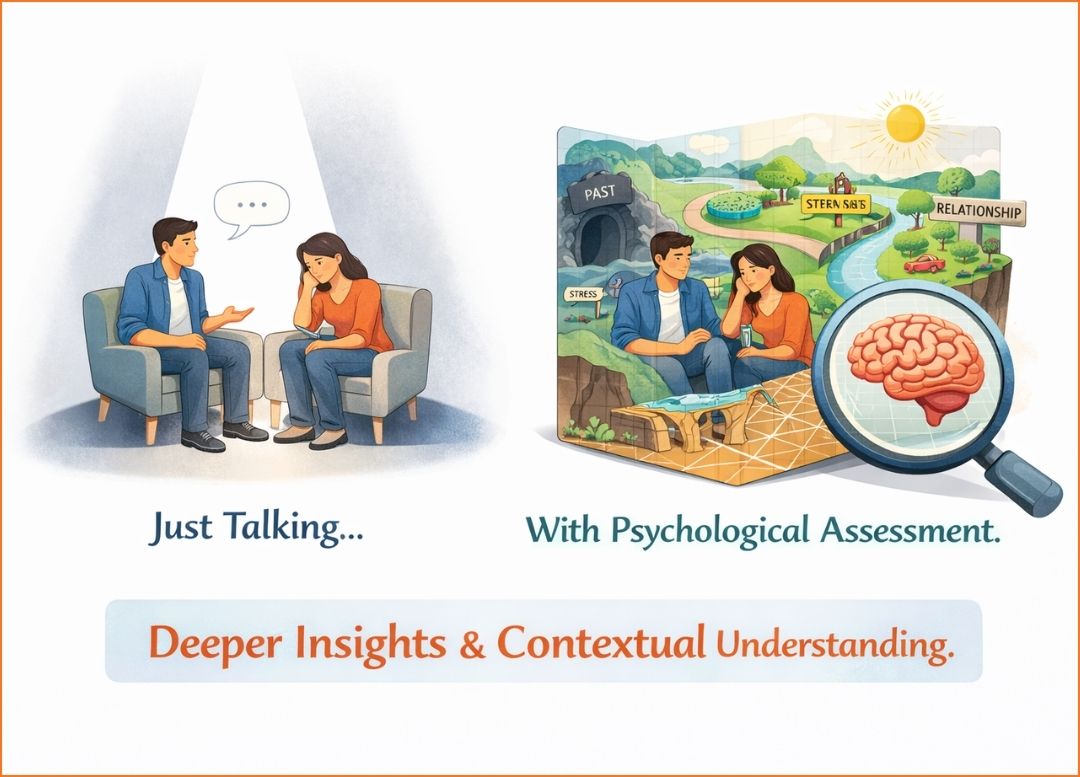
Therapy explores your story.
Assessment maps your psychological landscape.
When combined thoughtfully, they complement each other powerfully.
When Do Adults Benefit from Psychological Assessments?
In my years of practice at Disha Counselling Centre, I have found assessments particularly helpful when:
1. Progress Feels Stuck
Sometimes clients talk, reflect, and try strategies—but the core issue remains unclear. An assessment can reveal underlying anxiety patterns, personality structures, trauma responses, or cognitive tendencies that are not immediately visible in conversation alone.
2. There Is Confusion About Diagnosis
Is it depression? Is it burnout? Is it ADHD? Is it trauma-related stress?
Accurate assessment prevents mislabeling and ensures appropriate support.
3. Relationship Patterns Repeat
For couples, repeated conflict often stems from deeper personality traits, attachment styles, emotional regulation differences, or unprocessed past experiences.
Assessment provides neutral, structured insight—reducing blame and increasing understanding.
4. Major Life Decisions Are Involved
Career shifts, marriage decisions, separation, parenting stress, or long-standing emotional difficulties may require deeper clarity.
5. Self-Understanding Is the Goal
Some adults seek assessments not because something is “wrong,” but because they want:
- Greater self-awareness
- Clarity about strengths
- Insight into emotional triggers
- Understanding of interpersonal style
In these cases, assessment becomes a tool for growth—not just problem-solving.
How Psychological Assessments Enhance Counselling Outcomes
Over the past 20+ years at Disha Counselling Centre, we have seen how the assessment process has evolved—from basic testing models to more integrative, client-sensitive approaches.
Today, assessments are not about labeling people. They are about empowering them.
Here is how assessments enhance therapy:
1. They Provide Objective Perspective
Emotions can cloud perception. Assessments introduce structured data that helps both therapist and client see patterns clearly.
2. They Personalise Therapy
Instead of using a generic approach, therapy becomes tailored:
- Communication techniques are adjusted.
- Emotional regulation tools are customized.
- Relationship interventions are refined.
3. They Reduce Self-Blame
Many clients feel relief when they understand:
- “This is not a personal failure.”
- “This is a pattern that can be worked on.”
- “There is a name for what I am experiencing.”
Clarity often reduces shame.
4. They Improve Couples Work
For couples, assessments can:
- Identify attachment differences
- Clarify personality mismatches
- Highlight stress responses
- Reveal emotional regulation styles
When partners see structured feedback, conversations become less defensive and more constructive.
5. They Strengthen Treatment Planning
Assessments guide therapeutic direction, making the process more focused and effective.
A Word of Caution: Not All Assessments Are Equal
One concern I increasingly see is the use of online quizzes and unverified tools marketed as “psychological assessments.”
Many of these:
- Are not clinically validated
- Lack scientific reliability
- Are administered without proper interpretation
- Oversimplify complex psychological constructs
Clinical assessments must not be taken lightly.
They should be:
- Research-based
- Standardised and validated
- Administered ethically
- Interpreted by certified and authorised professionals
At Disha Counselling Centre, we ensure that every assessment tool we use meets professional standards and is administered responsibly. Interpretation is as important as the test itself.
A tool in the wrong hands can mislead.
A validated tool in trained hands can illuminate.
How the Assessment Process Has Evolved at Disha Counselling Centre
When we began integrating psychological assessments into our work over two decades ago, the approach was more formal and rigid.
Over time, it has matured into something more holistic.
Today:
- Assessments are integrated gently into the counselling journey.
- Clients are prepared and informed before testing.
- Results are discussed collaboratively—not delivered as verdicts.
- Emotional support accompanies interpretation.
We do not use assessments to define people.
We use them to understand people more deeply.
That distinction matters.
When Talking Isn’t Enough
Conversation is powerful. It builds trust, safety, and connection.
But sometimes, insight requires structure.
Sometimes clarity requires measurement.
Sometimes healing requires both empathy and evidence.
If you are an adult who feels stuck, or a couple navigating repeated patterns, a psychological assessment may provide the perspective you need—not as a replacement for therapy, but as an enhancement to it.
At Disha Counselling Centre, our goal has always been ethical, empathetic, and evidence-based care. Psychological assessments, when used responsibly, are not shortcuts. They are thoughtful tools that deepen understanding and strengthen the counselling process.
Because your wellness journey deserves both compassion and clarity.
Frequently Asked Questions About Psychological Assessment for Adults and Couples
1. What is a psychological assessment for adults?
A psychological assessment for adults is a structured, clinically validated evaluation conducted by a trained professional to understand emotional, behavioural, cognitive, or personality patterns. It helps guide accurate diagnosis and personalised therapy planning.
2. How is psychological assessment different from therapy?
Therapy is a conversational healing process focused on emotional growth and behavioural change. Psychological assessment uses scientifically validated tools to measure specific traits or concerns and provide objective insight that enhances therapy outcomes.
3. When should couples consider psychological testing?
Couples may benefit from psychological testing when:
- Conflicts are repetitive and unresolved
- Communication breaks down frequently
- There are emotional regulation differences
- One or both partners suspect deeper underlying concerns
Couples psychological testing provides structured clarity and reduces blame.
4. Are online psychological tests reliable?
Most online quizzes are not clinically validated and should not replace professional psychological assessment. Proper assessments must be research-based and administered by certified practitioners.
5. Can psychological assessment improve counselling outcomes?
Yes. Psychological assessments enhance counselling outcomes by:
- Providing objective data
- Personalising therapy plans
- Reducing misdiagnosis
- Offering deeper insight into behavioural patterns
6. Is psychological assessment only for people with severe mental health conditions?
No. Psychological assessments are also helpful for self-understanding, career clarity, relationship insight, and personal growth—not only for clinical diagnoses.
About the Author
Ms Samindara Sawant is a senior clinical psychologist and Co-Founder of Disha Counselling Centre with over two decades of experience in psychological assessments and psychotherapy. She holds an MA in Clinical Psychology from the University of Mumbai and a PG Diploma in Trauma Focused Therapy from TISS. Trained internationally in CBT (Beck Institute, USA), REBT (Albert Ellis Institute, USA), Systemic Family Therapy, Gestalt Therapy, and Clinical Hypnotherapy, she specializes in psycho-diagnostics for children, adolescents, adults, and couples. Samindara integrates evidence-based assessment tools with a holistic therapeutic approach to provide ethical, comprehensive, and personalised care.