
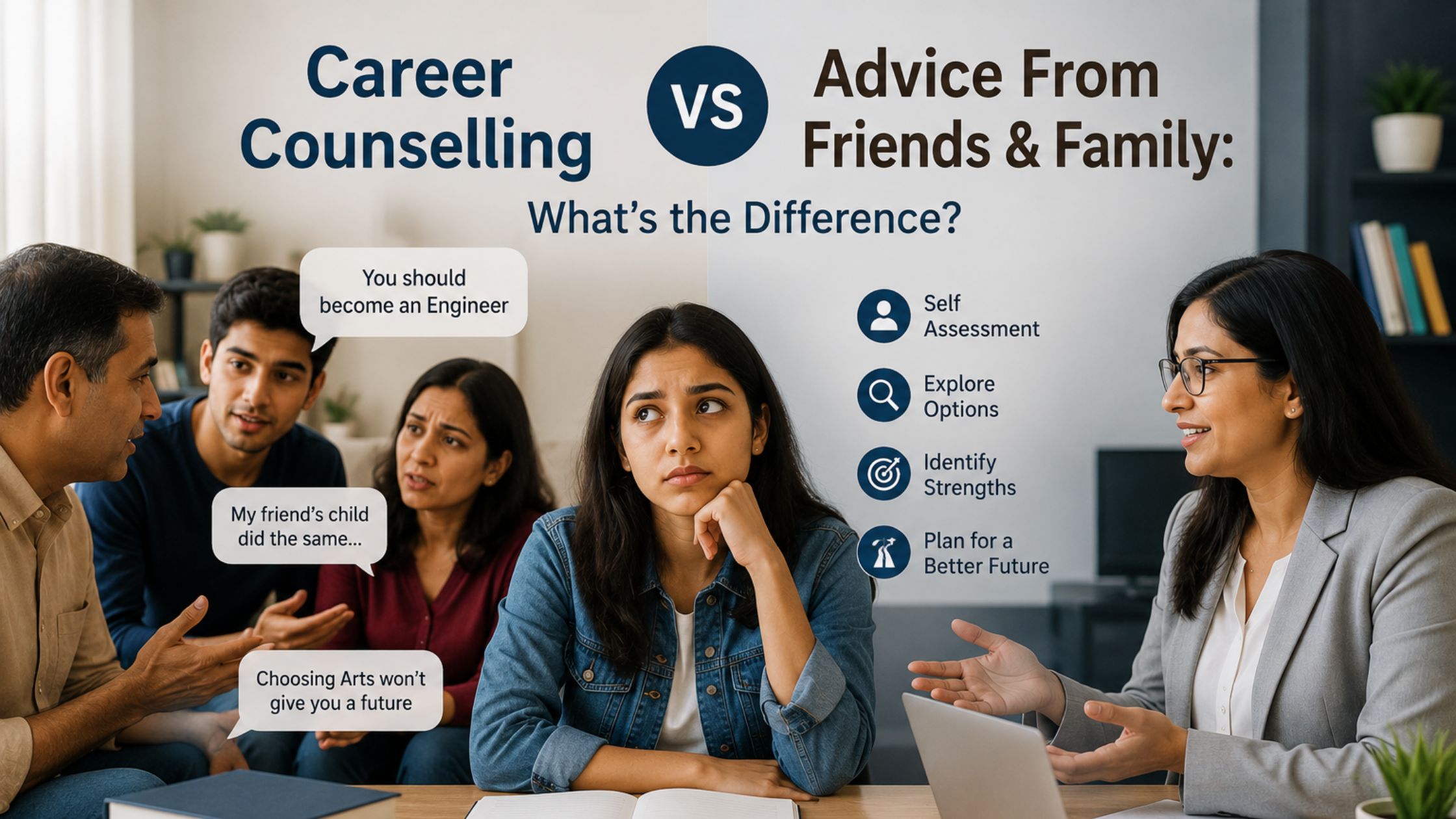
At some point, almost every student hears career advice from everywhere.
A relative says, “Take Science, it keeps your options open.”
A friend says, “AI and data science are the future.”
A teacher suggests, “Commerce will be better for you.”
Someone in the family says, “Government jobs are the safest.”
And another person confidently says, “Don’t take Arts, there’s no scope.”
Most of this advice comes from a good place. People are usually trying to help. Parents want security for their child. Teachers want students to choose wisely. Friends share what they are hearing. Relatives speak from their own experience or from what they have seen work for someone else.
But by the end of all these conversations, many students don’t feel clearer. They feel more confused.
Because suddenly, one career decision is surrounded by ten different opinions. Each person sounds confident. Each suggestion feels important. And the student is left wondering, “Whom should I actually listen to?”
This is where an important difference needs to be understood. Career advice and career counselling are not the same thing.
Advice usually tells a student what someone else thinks they should do. Career counselling helps a student understand what may actually fit them. And that difference can completely change the quality of a decision.
Why Everyone Has an Opinion About Careers
Career decisions are emotional for families.
A parent does not want their child to struggle later. A relative may want to protect the student from a field they believe is risky. A teacher may suggest something based on academic performance. A friend may recommend a path because it sounds exciting or popular.
None of this is necessarily wrong. The problem begins when advice is treated as a complete answer.
Most career advice comes from limited personal experience. Someone may suggest engineering because it worked well for their child. Someone may recommend finance because they know a person earning well in that field. Someone may discourage design, psychology, media, or liberal arts because they don’t fully understand how these careers have evolved today. But one person’s experience cannot become every student’s roadmap.
A career that worked beautifully for one student may feel completely wrong for another. A course that looks safe from the outside may not match a student’s interests, personality, or working style. A career that appears risky to one generation may actually be highly relevant in today’s job market.
This is why advice can be helpful as information, but risky as the only basis for decision-making.
The Problem Is Not Advice. The Problem Is One-Size-Fits-All Advice.

It is important to say this clearly: advice from family and friends is not useless.
Sometimes, it opens the student’s mind. It introduces them to careers they had not thought about. It gives practical insights about colleges, exams, industries, or real-world experiences.
But advice becomes confusing when it does not consider the student as an individual.
For example, two students may both score well in Science. One may enjoy research, logic, and structured problem-solving. Another may score well only because they are disciplined, but may actually feel more drawn toward people, creativity, writing, communication, or business.
If both students receive the same advice simply because their marks are similar, one of them may eventually feel misplaced.
That is why marks alone cannot decide a career. Popular trends cannot decide a career. Family expectations alone cannot decide a career.
A good career decision needs to consider the student’s aptitude, interests, personality, emotional readiness, and long-term fit. This is where professional career counselling becomes different.
What Career Counselling Actually Does
Many people misunderstand career counselling. They assume a counsellor will simply say, “You should become this,” or “This career is best for you.”
But good career counselling is not about forcing a student into one fixed answer. It is about helping the student understand themselves more clearly so that the decision becomes more informed.
A career counsellor does not begin with the question, “Which career is popular right now?” The process begins with the student.
What does the student think? What are they naturally good at? What subjects or activities keep them engaged? What kind of work environment may suit them? Do they enjoy working with people, ideas, numbers, systems, creativity, or practical problem-solving?
These questions matter because careers are not lived in theory. They live every day.
A student may like the idea of a career but not enjoy the actual day-to-day work it involves. Another student may dismiss a field simply because they do not understand it well enough yet. Career counselling helps bridge this gap between assumption and reality.
Advice Often Says, “This Worked for Someone Else.” Career Counselling Asks, “What Is Likely to Work for You?”
This is perhaps the simplest way to understand the difference. Advice is often based on someone else’s story.
“My neighbour’s son did engineering and is doing very well.”
“My cousin took commerce and got a great job.”
“My friend is studying abroad, so that must be better.”
“This field has scope, so you should take it.”
Career counselling looks at the student’s own profile.
It asks: Does this field match how the student thinks? Does it connect with their interests? Does their personality suit the kind of work this career demands? Are they likely to feel engaged in this path over time?
This is important because success is not just about entering a field. It is about sustaining growth in that field.
A career may have scope, but if the student feels disconnected from it, that path can become stressful. On the other hand, when a career aligns with the student’s strengths and interests, motivation often becomes more natural.
The student does not have to be pushed constantly because the path begins to feel meaningful.
Why Students Feel More Confused After Listening to Too Many People
Today’s students already live with a lot of pressure. They are expected to perform well academically, choose the right stream, select the right college, prepare for competitive exams, and think about future careers earlier than ever before.
On top of that, they are surrounded by constant opinions.
Social media tells them one thing. Friends say another. Parents worry about stability. Relatives discuss “scope.” Teachers talk about marks. Online videos predict future careers.
The result is information overload. Instead of clarity, the student experiences decision fatigue.
They may start questioning every option. They may change their mind repeatedly. They may avoid the topic altogether because it feels too overwhelming.
This is why structured guidance becomes important. Career counselling does not add more noise. It helps organize the noise. It helps students slow down, understand themselves, evaluate options, and make decisions with more confidence.
Why Two Students Should Not Receive the Same Career Advice
This is something many families overlook. Two students may be in the same class, score similar marks, and even choose the same subjects. But internally, they may be very different.
One student may be highly analytical and enjoy independent problem-solving. Another may be people-oriented and thrive in communication-based environments. One may enjoy structure and predictability. Another may do better in creative, flexible spaces.
If both are given the same career advice simply because they belong to the same stream, the guidance becomes incomplete. Career counselling recognizes these differences.
It looks beyond the surface and tries to understand the student as a whole. This is why tools like psychometric assessments can be helpful when interpreted properly. They give insight into aptitude, interests, personality, and preferences, which makes the counselling process more structured.
The goal is not to label the student. The goal is to understand the student better.
Advice Tells You What Worked for Someone Else. Career Counselling Helps You Understand What May Work for You.
Imagine two students sitting in the same classroom. They have similar marks, belong to the same stream, and are preparing to make important career decisions. On paper, they look almost identical.
But once you begin understanding them, the differences become obvious. One student enjoys solving analytical problems and prefers working independently. The other loves interacting with people, communicating ideas, and leading group activities. One feels energised by structure and routine, while the other thrives in creative and flexible environments.
If both students simply receive the advice, "You should become an engineer because you scored well in Science," the guidance ignores everything that makes them different as individuals. This is where career counselling takes a completely different approach.
Advice often begins with someone else's experience. A relative may recommend a profession because it worked well for their child. A friend may suggest a course because it is currently popular. A teacher may focus mainly on academic performance. While these suggestions are usually well-intentioned, they are based on external observations rather than the student's complete profile.
Career counselling begins somewhere else. It begins with the student.
Instead of asking, "Which career has the most scope?" a counsellor first tries to understand questions like: How does this student think? What genuinely interests them? What kind of work environment suits their personality? What are their natural strengths?
Only after understanding these answers do career options begin to make sense. In simple words, advice often answers the question, "What worked for someone else?"
Career counselling answers a much more important question: "What is likely to work for you?"
That is why two students with similar marks may walk away with completely different career recommendations—and both decisions can be equally right.
Because the goal is not to find the most popular career. The goal is to find the career that is most compatible with the student choosing it.
When Family Advice Can Be Helpful
There are many moments when family advice genuinely helps. Parents often understand a child’s habits, temperament, and emotional patterns better than anyone else. Teachers may notice academic strengths. Friends may know what the student enjoys or avoids. Relatives may provide practical exposure to certain professions.
All of this can be valuable. But it becomes most useful when it is treated as input, not pressure.
A student can listen to different perspectives without feeling forced to follow every suggestion. Parents can gather information from others without making decisions only through comparison.
The healthiest career decisions usually happen when advice, self-awareness, and professional guidance work together.
Why Professional Guidance Matters More Today Than Before
Career choices today are far more complex than they were earlier.
A few decades ago, career paths felt more predictable. Today, new careers are emerging constantly. Fields like data science, UX design, psychology, digital marketing, liberal arts, sustainability, media, entrepreneurship, and many others are becoming serious options.
At the same time, traditional fields are also changing. Engineering is not just engineering anymore. Commerce is not just CA or banking. Arts is not limited to teaching or writing. Science does not only mean medicine.
This changing landscape makes decision-making more difficult for students and parents.
Professional career counselling helps students understand not only what options exist, but which options connect with their individual profile.
That distinction matters. Because the goal is not to chase the most popular career. The goal is to choose a direction where the student can grow with clarity and confidence.
How Disha Counselling Centre Helps Students Make Better Career Decisions
At Disha Counselling Centre, career guidance is not approached as a one-line answer.
The process focuses on understanding the student deeply before suggesting possible pathways.
Through structured psychometric assessments and one-on-one counselling, students gain clarity about their aptitude, interests, personality, learning style, and career preferences. These insights are then connected to real-world options, so the student and parents can understand why certain paths may be more suitable than others.
This approach helps reduce confusion because decisions are not based only on trends, marks, or outside opinions.
They are based on the student’s actual strengths and suitability. For parents, this also brings reassurance. Instead of feeling that they are guessing or relying only on scattered advice, they begin to see the decision through a clearer, more structured lens.
And for students, this can be deeply relieving. Because they finally feel seen as individuals, not just marks, streams, or career expectations.
The Final Thought
Career advice will always be around. Friends will have opinions. Relatives will suggest options. Teachers will guide from their experience. Parents will naturally want what feels safest and best.
And that is not wrong. But a student’s future should not be decided only by the loudest opinion in the room. It should be shaped by understanding.
Understanding what the student is good at. Understanding what keeps them engaged. Understanding what kind of work environment may suit them. Understanding where their strengths and personality can grow over time.
Because the right career decision is not always the most popular one. It is not always the one someone else succeeded in. It is the one that fits the student well enough to build a meaningful future.
Advice can start the conversation. But career counselling helps give that conversation direction.
FAQs
Is career advice from family always wrong?
No. Family advice can be helpful, but it should not be the only basis for a career decision.
How is career counselling different from normal advice?
Career counselling is based on the student’s aptitude, interests, personality, and career fit, not just personal opinion.
Can friends help in career decisions?
Friends can share perspectives, but students should avoid choosing careers only because their friends are choosing them.
Does career counselling tell students exactly what to do?
No. Good career counselling helps students understand themselves and make informed decisions.
When should a student consider career counselling?
A student should consider counselling when they feel confused, pressured, or unsure about which stream, course, or career path suits them best.