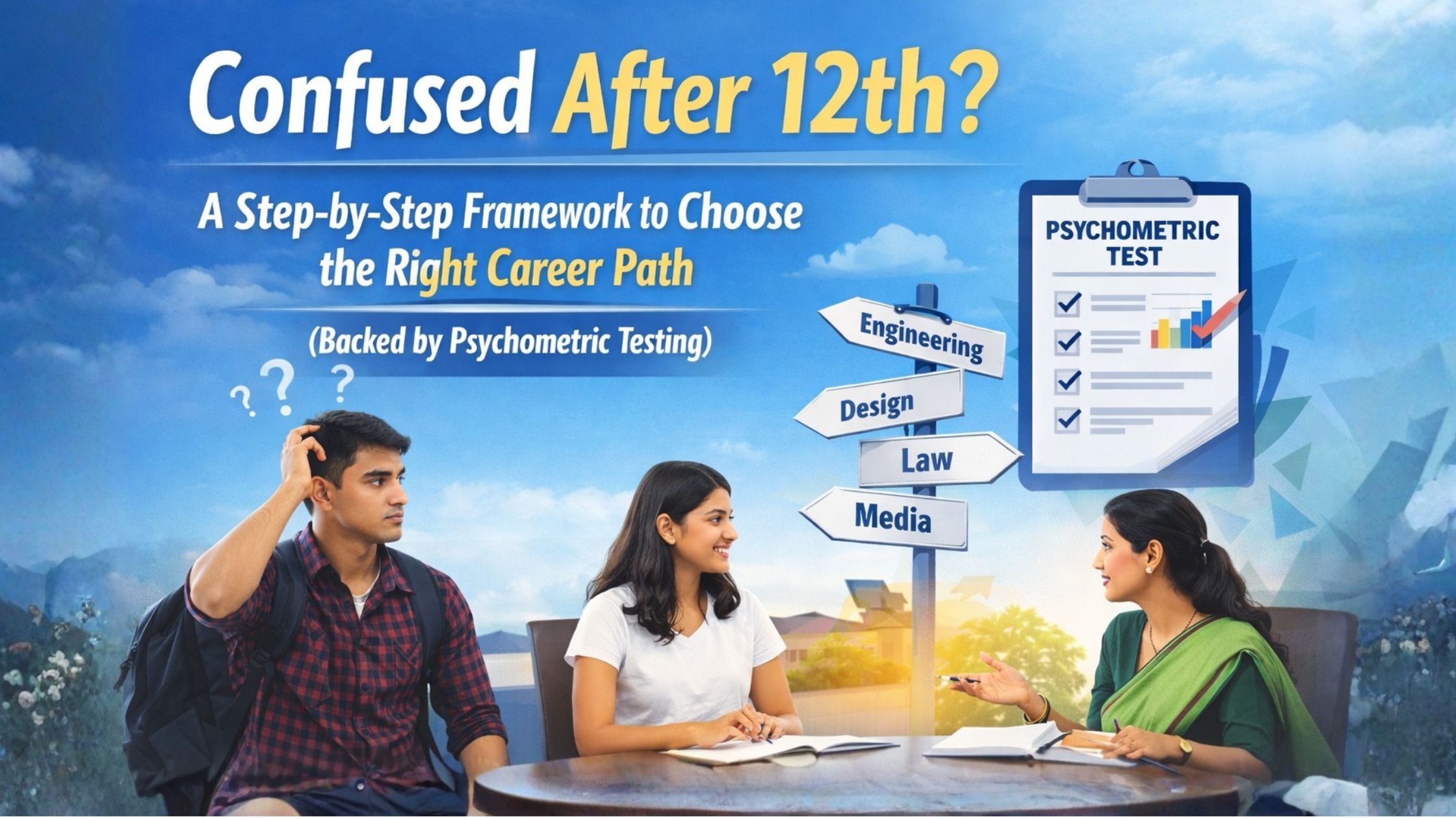
“Everyone keeps asking me what I want to do next… but I genuinely don’t know.”
For many students, this thought becomes louder right after Class 12. What was once a distant question suddenly turns into an urgent decision.
Parents start exploring options. Friends begin making choices. Deadlines approach.
And in the middle of all this, the student is expected to decide often without enough clarity.
It’s important to pause here and understand something: This confusion is not a weakness. It’s a sign that the decision matters.
Why This Phase Feels So Overwhelming
After Class 12, the number of choices increases significantly. Engineering, design, psychology, business, law, media each path comes with its own possibilities.
But more options don’t always mean more clarity.
In fact, they often create:
- Overthinking
- Fear of making the wrong decision
- Pressure to “figure it all out quickly”
Students are not just choosing a course. They are trying to choose a direction for their future without fully understanding themselves yet.
Common Mistakes Students Make After 12th
In this state of confusion, decisions are often influenced by external factors.
Some students choose based on marks assuming high scores automatically define the right career. Others follow peers, trends, or what seems “safe” at the moment.
Sometimes, decisions are made to meet expectations rather than personal alignment.
These choices may feel practical initially, but over time, they can lead to:
- Lack of interest
- Low motivation
- A constant feeling of being “misplaced”
Not because the student isn’t capable but because the choice wasn’t aligned.
What Actually Matters While Choosing a Career

A meaningful career decision is rarely about one factor. It comes from the alignment of three key elements:
Aptitude reflects what a student is naturally good at how they think, solve problems, and process information.
Interest reflects what keeps them engaged in what they are curious about and willing to invest time in.
Personality reflects how they function in the real world, their preferences, behavior, and working style.
When these three come together, learning feels more natural, and growth becomes more sustainable.
Without this alignment, even a “good” career can feel difficult to sustain.
Why Self-Understanding Is Often Missing
Most students are asked to make career decisions before they are given the tools to understand themselves.
They may know their marks, but not their strengths.
They may know available courses, but not what suits them.
This gap between decision-making and self-awareness is where confusion begins.
And this is exactly where structured approaches like psychometric testing and career guidance become valuable not as a shortcut, but as a foundation for clarity.
What is Psychometric Testing and How Does It Work?
Psychometric testing is a scientific method used to assess a student’s aptitude, interests, and personality.
It is not a test of knowledge. It does not measure how much you have studied. Instead, it focuses on how you think, what you prefer, and where your strengths lie.
Through carefully designed questions and validated frameworks, it creates a profile that highlights:
- Natural abilities
- Areas of interest
- Behavioral tendencies
This profile then becomes a guide not a final answer, but a starting point for informed decision-making.
Why Psychometric Testing Matters
One of the biggest advantages of psychometric testing is that it removes guesswork.
Instead of relying only on opinions or assumptions, students get insights that are:
- Structured
- Objective
- Personalized
It also helps in discovering career paths that students may not have considered earlier.
More importantly, it gives students a sense of direction, reducing anxiety and helping them move forward with confidence.
A Step-by-Step Framework to Choose the Right Career
Career decisions become easier when they are approached step by step, rather than all at once.
The first step is understanding oneself through reflection or structured assessment.
The second step is exploring career options that align with this understanding.
The third step is shortlisting realistic and suitable paths, based on both interest and ability.
The fourth step is evaluating these options in terms of future scope, lifestyle, and growth.
And finally, making a decision that feels informed, not rushed.
This process may take time, but it leads to far more stable and confident choices.
A Real-Life Scenario
A student, after scoring well in Class 12 Science, chose engineering because it seemed like the natural next step.
However, within the first year, they began to feel disconnected. The subjects felt forced, motivation dropped, and self-doubt increased.
Later, through a structured career assessment, it became clear that their strengths lay in creativity, visual thinking, and user experience.
They transitioned into design and the difference was visible. Engagement improved, confidence returned, and the learning process felt meaningful again.
The issue was never capability. It was an alignment.
How Disha Helps Students Move from Confusion to Clarity
At Disha Counselling Centre, the focus is not just on suggesting careers but on helping students understand themselves first.
The process begins with structured psychometric assessments that provide insight into aptitude, interests, and personality.
This is followed by one-on-one counselling sessions where these insights are explained, explored, and connected to real-world career options.
Instead of overwhelming students with choices, the approach is to simplify decisions through clarity.
With the help of career guidance and assessment programs, students are able to move from confusion to a clear, step-by-step plan that feels both realistic and aligned.
A Thought to Reflect On
Choosing a career after 12th can feel like a one-time, high-pressure decision.
But in reality, it is the beginning of a journey that will evolve over time.
What matters at this stage is not perfection, but direction.
A direction that feels aligned.
A direction that allows growth.
A direction that is chosen with understanding, not pressure.
Because when clarity replaces confusion, decisions become easier and the path ahead begins to feel more certain.
FAQs
What if I am confused even after exploring different options?
That’s completely normal. Confusion often means you need deeper clarity, not more options. Structured guidance or assessments can help simplify the decision.
Are psychometric tests accurate?
When designed and interpreted correctly, they provide valuable insights into aptitude, interests, and personality. They are meant to guide decisions not force them.
Can I change my career later if I choose the wrong path?
Yes. Many students shift paths as they gain more clarity. However, making an informed decision early can reduce unnecessary stress and changes later.
Should parents decide the career for their child?
Parents play an important role in guiding, but the decision works best when it is collaborative and based on the student’s strengths and preferences.
When should I consider career counselling?
If you feel stuck, overwhelmed, or unsure about your direction, it’s a good time to seek guidance. It helps bring structure and clarity to the decision-making process.