
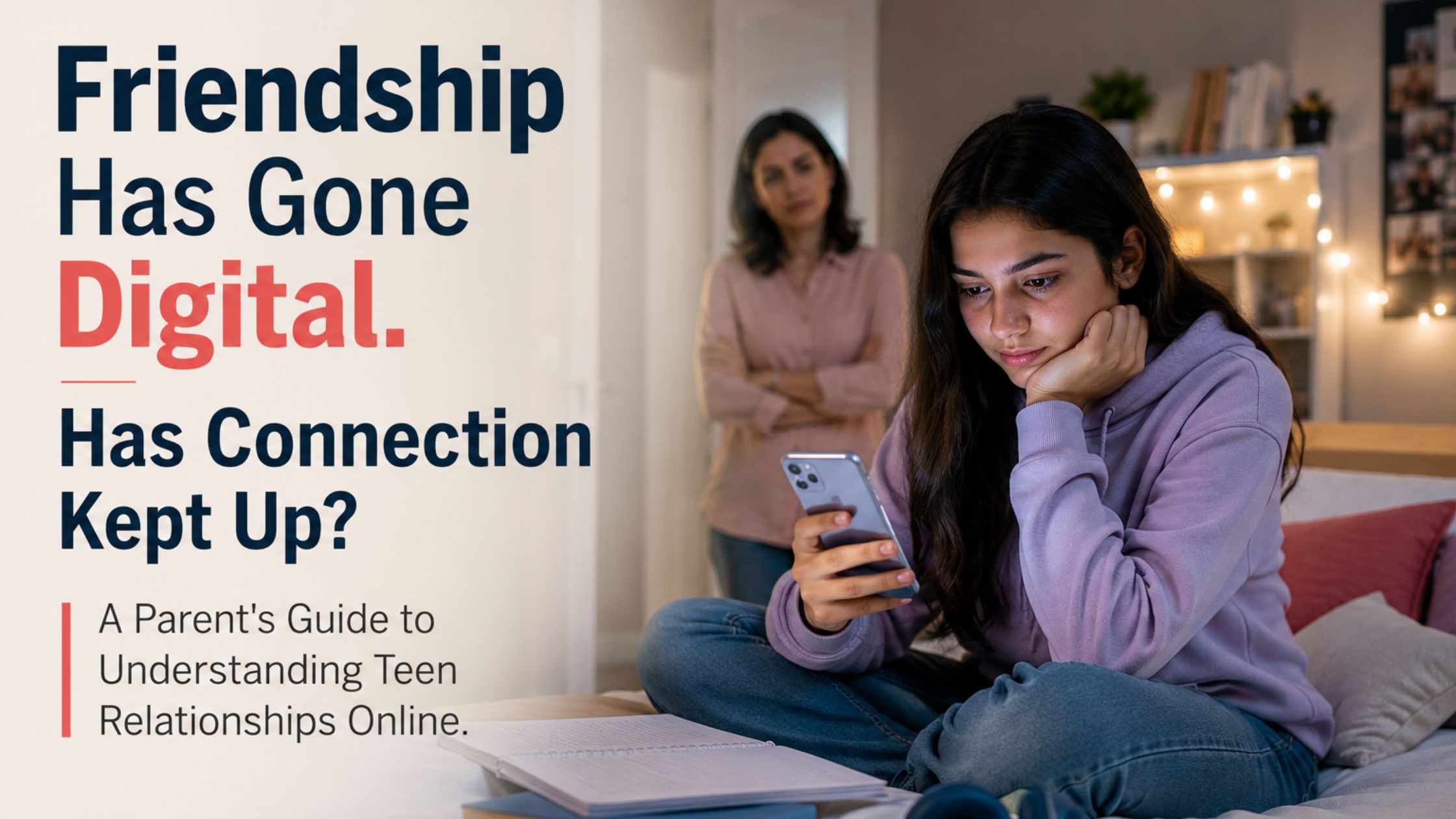
There was a time when parents knew exactly where friendships happened.
Children met in school, played in the neighbourhood, cycled together in the evenings, celebrated birthdays, and spent hours talking face-to-face. If a parent wanted to know who their child's friends were, they simply had to step outside or wait until everyone gathered after school. Today, that picture looks very different.
A teenager may spend an entire evening laughing, talking, and sharing experiences with friends without ever leaving their room. Their closest friendships may exist across school corridors, Instagram messages, WhatsApp groups, Discord servers, online gaming platforms, or video calls. Conversations begin in the classroom, continue on social media, and end late at night in a group chat.
For many parents, this shift can feel confusing.
When they see their child constantly looking at a screen, it is natural to wonder: "Are they actually spending time with friends, or are they simply spending more time on their phone?" It is an understandable concern.
After all, headlines often warn us about excessive screen time, cyberbullying, online predators, artificial intelligence, social media addiction, and declining attention spans. It can begin to feel as though technology is quietly replacing real human relationships.
But perhaps the more important question is not whether friendships have moved online. It is whether genuine connection has managed to keep up.
Because while the place where friendships begin may have changed, every young person still longs for exactly the same thing they always have.
To feel understood. To belong. To know that someone genuinely cares about them. The challenge for parents today is not deciding whether online friendships are real or fake.
The challenge is understanding what a healthy connection looks like in a digital world.
Friendship Has Changed. It Hasn't Disappeared.
One of the biggest misconceptions about today's teenagers is that they have stopped forming meaningful friendships.
In reality, friendships haven't disappeared. They've simply become more fluid.
A teenager might spend the morning chatting with classmates during school, continue the same conversation through a WhatsApp group while travelling home, play an online game with those friends in the evening, and later join a Discord call to work on a school project.
To adults, these interactions may appear fragmented. To teenagers, they often feel like one continuous friendship. The digital world has blurred the boundaries between online and offline relationships.
Friendship no longer exists in one place. It moves with them throughout the day.
This shift is supported by broader trends as well. Today, the overwhelming majority of teenagers own or regularly use smartphones, making digital communication an ordinary part of growing up rather than an exception.
But owning a smartphone does not automatically mean a teenager feels connected. Someone can receive hundreds of notifications every day and still feel incredibly lonely.
Similarly, a student with only a handful of close friends may feel deeply supported because those relationships offer trust, understanding, and emotional safety.
That is why parents may benefit from changing one important question.
Instead of asking: "How much time are they spending online?"
Perhaps we should first ask: "Who are they connecting with while they're there?"
Because the quality of connection matters far more than the location where it happens. A genuine friendship is not defined by whether it exists online or offline.
It is defined by whether someone checks in when life becomes difficult, remembers important moments, celebrates achievements, notices when something feels different, and continues showing up even when conversations are not easy.
Those qualities have never depended on geography. They depend on the relationship itself.
More Screen Time Doesn't Always Mean More Connection

One of the most common conversations happening in homes today revolves around screen time.
Parents worry that their children are spending too many hours on their phones. They notice devices at the dining table, messages during family conversations, and late-night scrolling before sleep. Naturally, many conclude that reducing screen time is the answer.
While screen habits certainly deserve attention, the conversation is often more complex than simply counting hours.
The real question is not always how much time a teenager spends on a screen.
The more meaningful question is:
What is that screen replacing?
If digital communication is replacing every opportunity for face-to-face interaction, physical activity, hobbies, sleep, family conversations, or academic focus, then it deserves careful attention.
But if technology is helping students maintain healthy friendships, collaborate with classmates, stay connected to family members, or explore interests responsibly, the picture becomes much more balanced.
Face-to-face relationships continue to teach important emotional skills that digital communication cannot fully replace.
Teenagers learn to notice subtle facial expressions, understand pauses in conversation, interpret body language, manage uncomfortable silence, resolve disagreements respectfully, and develop empathy through shared physical experiences.
These are skills that develop naturally when people spend time together in person. Digital communication, while valuable, does not always provide the same opportunities.
This does not mean online friendships are less meaningful. It simply means that healthy development usually requires both digital and real-world interactions. The goal is not to eliminate technology from teenagers' lives.
It is to make sure technology does not quietly replace experiences that are equally important for emotional growth.
For Some Teenagers, The Internet Is More Than Entertainment
Many discussions about social media focus almost entirely on its risks. While those risks certainly exist, there is another reality that deserves equal attention.
For some teenagers, online spaces become the first place where they genuinely feel understood. Imagine a student who struggles to find people with similar interests in school.
Or a teenager who feels different because of their identity, culture, personality, or life experiences.
For these young people, online communities can offer something they may not easily find in their immediate surroundings: Acceptance.
Teenagers who are neurodivergent, questioning aspects of their identity, living in socially isolated environments, or simply feeling misunderstood often discover communities where they finally realise they are not alone.
Sometimes, an online conversation becomes the first place where they feel comfortable expressing thoughts they have never shared offline.
Sometimes, a gaming community becomes the first group where they feel included.
Sometimes, a creative platform helps them discover people who genuinely appreciate their interests rather than judge them.
These experiences should not be dismissed simply because they happen through a screen.
Many meaningful friendships today genuinely begin online before becoming trusted parts of a teenager's emotional world. However, this is also where balance becomes essential.
The same spaces that offer belonging can also expose teenagers to cyberbullying, manipulation, misinformation, unhealthy communities, or relationships that are not always what they seem.
This is why the conversation should not be about deciding whether the internet is "good" or "bad."
It should be about helping young people develop the judgment to recognise the difference between healthy and unhealthy digital relationships.
That ability often described as digital literacy may become one of the most important life skills this generation develops. Because technology will continue evolving. The real challenge is ensuring that emotional wisdom evolves alongside it.
When AI Starts Feeling Like a Friend
One of the newest changes in teenagers' digital lives is not just social media or online gaming. It is artificial intelligence.
Many young people today are chatting with AI-powered tools for homework, creative writing, brainstorming ideas, or simply passing time. Others are spending hours talking to AI companions designed to have conversations that feel warm, supportive, and personal.
For parents, this can feel unfamiliar. How can a teenager become emotionally attached to something that isn't a real person?
The answer lies less in the technology itself and more in what it offers.
An AI never gets tired. It never says, "I'm busy." It doesn't interrupt. It responds immediately, at any hour of the day or night.
For a teenager who feels lonely, misunderstood, or hesitant to open up to someone else, that kind of constant availability can feel comforting. But there is an important difference between being available and being emotionally present.
Artificial intelligence can generate responses that sound empathetic, but it does not experience concern, remember relationships in the way humans do, or understand the full context of a young person's life. It cannot notice changes in a teenager's behaviour over weeks or months, recognise when something they say is unusually out of character, or understand the subtle emotional history behind a difficult conversation.
Most importantly, AI cannot replace the trust, accountability, and genuine care that develop within healthy human relationships.
This does not mean parents need to fear or ban AI.
Like every new technology, it has benefits when used thoughtfully. It can support learning, encourage curiosity, and even help teenagers organise their thoughts.
The real question is whether AI is becoming one resource among many, or the only place where a teenager feels able to share their struggles.
If every difficult emotion is being taken only to a chatbot, it may be worth gently asking why speaking to a real person feels harder.
Often, the solution is not removing AI from a teenager's life.
It is helping them feel that home remains a place where difficult conversations are equally welcome.
What Healthy Online Friendships Often Look Like
Parents sometimes worry because they cannot see digital friendships in the same way they could see neighbourhood friendships years ago.
When children played outside, adults naturally observed who they spent time with. Online friendships are different.
Much of the interaction happens privately, making it harder to know whether those relationships are helping or hurting.
Fortunately, healthy friendships usually leave signs beyond the screen. Think about how your teenager seems after they put their phone away.
Do they appear relaxed? Do they seem happier than before? Do they excitedly tell you about a funny conversation, a shared joke, or something thoughtful a friend said?
Healthy friendships often leave a positive emotional footprint. Teenagers come away feeling understood rather than judged. They feel encouraged rather than drained.
They speak about the people behind the usernames instead of treating every interaction as anonymous entertainment.
Another encouraging sign is when teenagers can explain why a friendship matters to them. Perhaps they admire someone's kindness. Maybe they enjoy common interests. Or perhaps they simply feel accepted around that person.
These explanations suggest the relationship is built on genuine connection rather than convenience or popularity. Healthy digital friendships also make space for life outside the screen.
Teenagers continue participating in school, spending time with family, pursuing hobbies, and maintaining offline relationships. The phone becomes one way of staying connected, not the only way.
Parents do not need to know every message exchanged. But understanding how those friendships make their child feel can reveal far more than checking a chat history ever could.
When Should Parents Be Concerned?
Every friendship has disagreements. Every teenager experiences occasional mood swings. Every family has moments when communication feels difficult.
These experiences alone are not reasons to panic.
The bigger picture matters far more than any single incident.
Sometimes parents notice that after spending time online, their teenager becomes unusually withdrawn, irritable, or anxious. They may seem emotionally exhausted after conversations that should have been enjoyable.
Perhaps they constantly worry about responding immediately to messages or become distressed when excluded from a group chat.
Sometimes a friendship begins to feel one-sided. One person reaches out only when they need help, attention, or reassurance. The relationship slowly becomes emotionally draining instead of mutually supportive.
Parents may also notice that sleep begins to suffer. Homework is neglected. Activities once enjoyed lose their appeal. Face-to-face friendships gradually disappear.
Or their teenager becomes unusually secretive in ways that feel driven by fear rather than a healthy desire for privacy.
None of these signs automatically mean something is seriously wrong. Teenagers naturally seek greater independence as they grow. Privacy is a normal part of adolescence.
What deserves attention is not one isolated behaviour. It is a pattern.
Patterns tell us whether online relationships are supporting emotional wellbeing or quietly beginning to replace other important parts of life.
When parents notice these patterns, the goal is not immediate intervention. It is a curiosity. A calm conversation is often far more effective than an immediate reaction.
The Parenting Responses That Often Backfire
When parents feel worried, they naturally want to protect their children. Sometimes that protective instinct leads to quick decisions. The phone is taken away.
Social media is banned overnight. Messages are checked without permission. Online friends are dismissed as "not real." These responses usually come from love. But they do not always create the outcome parents hope for.
Teenagers who fear losing access to their phones often become better at hiding what they do online rather than becoming more open about it.
A child who feels judged for having online friendships may stop mentioning those relationships altogether.
When trust begins to disappear, opportunities for meaningful conversations often disappear with it.
This does not mean parents should ignore genuine safety concerns or avoid setting healthy boundaries. Boundaries remain important.
Rules have an important place in helping teenagers navigate digital spaces responsibly. But boundaries work best when they are built alongside trust rather than replacing it.
Young people are far more likely to seek help when they believe they will be listened to before being punished.
If a teenager experiences cyberbullying, manipulation, or an uncomfortable interaction online, they need confidence that telling a parent will lead to support—not immediate blame or loss of every digital privilege.
Ultimately, the goal is not to control every aspect of a teenager's online life.
The goal is to remain someone they continue turning to when life becomes confusing, uncomfortable, or overwhelming.
Because long after parental controls become outdated and apps continue changing, the quality of that relationship will remain one of the strongest protective factors in a young person's life.
Replacing Monitoring with Meaningful Conversations
One of the biggest challenges parents face today is knowing how to start conversations about their teenager's online life.
It is understandable to begin with questions like, "How long have you been on your phone?" or "Why are you always messaging someone?" After all, these are the concerns parents notice most easily.
But teenagers often hear something different. Instead of hearing curiosity, they hear criticism. Instead of feeling invited to talk, they feel they have to defend themselves.
This is why many conversations about technology end before they truly begin. A small shift in the questions we ask can make a significant difference.
Rather than focusing only on the device, try focusing on the people and experiences behind it.
Questions such as:
"Who made you laugh today?"
"Is there someone online you genuinely enjoy talking to?"
"Have you ever felt uncomfortable because of something that happened online?"
"What do you enjoy most about this app?"
These questions communicate something important. They tell teenagers that you are interested in understanding their world, not simply policing it. Parents do not need to become experts in every social media platform.
They simply need to remain approachable enough that their child feels comfortable sharing both the good experiences and the difficult ones.
In many families, the strongest protection does not come from the strictest rules. It comes from the strongest conversations.
Digital Literacy Is a Skill Families Can Build Together
For many parents, the internet still feels like a place children need protection from. For today's teenagers, however, the internet is also where they learn, collaborate, create, communicate, and maintain friendships.
The goal, therefore, cannot simply be keeping young people away from technology. It must be helping them use technology wisely. Digital literacy is much more than knowing how to use an app.
It includes recognising misinformation, understanding online privacy, setting healthy boundaries, identifying manipulation, questioning what appears on social media, knowing when to block or report someone, and understanding that not every online interaction deserves their attention.
Perhaps the most effective way to teach these skills is not through lectures but through shared conversations. Ask your teenager to show you how their favourite apps work.
Let them explain why certain platforms matter to them.
Discuss hypothetical situations together.
"If someone you didn't know asked for personal information, what would you do?"
"If a friend kept making you uncomfortable online, how would you handle it?"
"How do you know whether something you read online is actually true?"
These discussions encourage critical thinking rather than blind obedience.
They also communicate that learning about technology is something families can do together. The digital world changes quickly. New platforms appear.
Artificial intelligence continues to evolve. Online trends come and go.
Instead of trying to prepare teenagers for every possible situation, parents can help them develop the judgment to make thoughtful decisions, even when faced with something entirely new.
That may be one of the most valuable life skills they carry into adulthood.
Parenting in the Digital Age Is Less About Control and More About Connection
Every generation of parents has faced changes they did not grow up with. Previous generations worried about television. Later, it was video games.
Today, it is smartphones, social media, artificial intelligence, and an online world that evolves faster than anyone can keep up with.
While technology has changed dramatically, one thing has remained remarkably constant. Teenagers still need trusted adults.
They still need relationships where they can ask difficult questions without fear of judgment. They still need guidance while they gradually learn to make independent decisions. Technology has not changed those needs.
If anything, it has made them even more important. Parents do not have to understand every app their teenager uses. Nor do they need to eliminate every possible online risk.
What often matters most is creating a home where conversations remain open, curiosity replaces assumptions, and trust grows alongside healthy boundaries.
When teenagers know they can talk honestly about both positive and negative online experiences, they become far more likely to seek support when something genuinely goes wrong.
That relationship is far more powerful than any parental control setting.
Helping Teenagers Navigate Both the Digital and Real World
Growing up today means learning to build friendships across two worlds. One exists in classrooms, sports grounds, cafés, and family gatherings.
The other exists in group chats, gaming communities, social media platforms, and increasingly, conversations with artificial intelligence. Neither world is going away. The challenge is not choosing one over the other.
It is helping young people move confidently between both while protecting their emotional wellbeing.
Healthy friendships whether they begin online or offline—should help teenagers feel respected, understood, and supported. They should encourage confidence rather than anxiety, belonging rather than isolation, and growth rather than dependence.
As parents, we cannot choose every friendship our children will make. But we can influence something equally important. We can become the kind of adults they continue turning to when life becomes complicated.
Because in a world filled with notifications, algorithms, and endless digital conversations, the relationship that often matters most is still the one waiting for them at home.
For families who notice ongoing changes in a teenager's emotional wellbeing, social relationships, confidence, or behaviour, seeking psychological counselling and guidance for adolescents can provide a supportive space to understand what may be happening beneath the surface. Likewise, when emotional concerns begin affecting motivation, academic engagement, or future planning, career assessments and guidance can help students better understand their strengths, interests, and the factors shaping their decisions, allowing support to address both their emotional and developmental needs.
FAQs
Are online friendships real?
Yes. Many online friendships are genuine and meaningful. What matters most is whether the relationship is built on trust, respect, and mutual support rather than where it takes place.
How much screen time is too much for teenagers?
There is no single number that applies to every teenager. Instead of focusing only on hours, parents should consider whether screen use is affecting sleep, school, physical activity, offline relationships, or emotional wellbeing.
Should parents worry if their teenager talks to AI chatbots?
Not necessarily. Many teenagers use AI for learning, creativity, or curiosity. The concern arises if AI becomes their only source of emotional support or replaces meaningful human relationships.
What are the warning signs of unhealthy online friendships?
Persistent anxiety after going online, withdrawal from offline activities, declining sleep or academic performance, increased secrecy driven by fear, and emotionally one-sided relationships are all signs worth exploring through open conversation.
How can parents encourage safer digital habits?
Stay curious rather than judgmental, have regular conversations about online experiences, learn about the platforms your teenager uses, and help them build digital literacy instead of relying only on restrictions.