
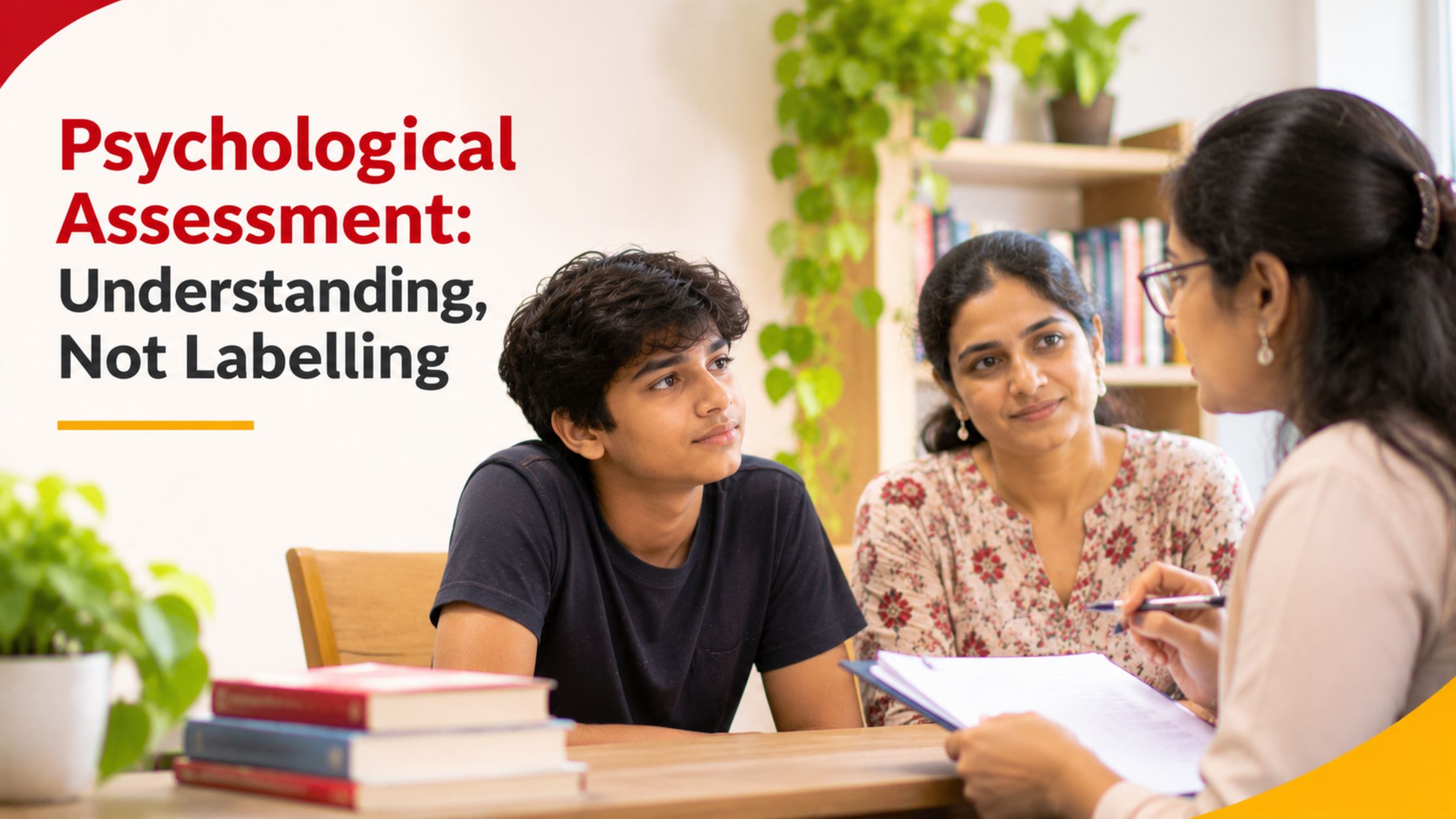
When parents are advised to consider a psychological assessment for their child, the suggestion can bring up several questions.
Does this mean something is wrong? Will the assessment give the child a label? Could the results affect how teachers or family members see them? What if the child begins to think of themselves differently?
These concerns are understandable, especially when psychological assessments are associated with diagnoses, intelligence scores, or identifying difficulties.
Consider a child who understands lessons during classroom discussions but struggles to complete written assignments. Their parents may wonder whether the problem is attention, motivation, learning ability, or something else entirely. Teachers may notice certain difficulties, but the child appears capable in other situations.
Without a clearer understanding, different adults may arrive at different conclusions. One person may describe the child as careless. Another may believe they need stricter discipline. Someone else may suggest that the child is simply not trying hard enough.
A psychological assessment, when appropriate, can help move the conversation beyond these assumptions.
The purpose of a thoughtful psychological assessment is not simply to identify what a child finds difficult. It is to understand their strengths, needs, and experiences so that support can be more appropriate and meaningful.
What Is a Psychological Assessment?
A psychological assessment is a structured process used by qualified professionals to understand particular aspects of a person's psychological functioning.
Depending on the reason for assessment, it may explore cognitive abilities, learning processes, attention, memory, emotional functioning, behaviour, developmental concerns, or other relevant areas.
It is important to understand that psychological assessment is not necessarily one test administered in a single sitting.
A comprehensive assessment may involve conversations with parents or caregivers, a review of developmental and educational history, observations, standardised psychological tests, questionnaires, and information from teachers or other relevant sources.
The methods used depend on the questions the assessment is intended to answer.
For example, an assessment exploring academic difficulties may involve different tools from one focused on emotional or behavioural concerns. Similarly, evaluating attention-related difficulties requires a different approach from understanding a child's intellectual abilities.
A thoughtful assessment begins by identifying the concern clearly rather than administering tests without a specific purpose.
The aim is to gather information from appropriate sources and interpret it within the context of the child's development and everyday life.
Why Understanding the Child's Context Matters

A child's behaviour or academic performance rarely exists independently of their environment.
Consider a student who struggles to concentrate in class. The difficulty might relate to attention regulation, but other possibilities may include insufficient sleep, anxiety, gaps in understanding, classroom distractions, or emotional concerns.
Similarly, a child who avoids schoolwork may be struggling with a learning difficulty, feeling overwhelmed by academic expectations, or responding to repeated experiences of failure.
Observing the behaviour alone does not establish its cause.
This is why a psychological assessment should consider the circumstances in which difficulties occur.
A professional may explore when the concern began, whether it appears across different settings, how frequently it occurs, and whether particular situations make it better or worse.
The child's developmental history, educational experiences, family circumstances, language background, health, and current stressors may also be relevant.
This broader understanding helps prevent conclusions based on isolated behaviours.
A child who appears inattentive during a particular subject may not experience the same difficulty elsewhere. A teenager who has recently become withdrawn may be responding to a significant life change rather than demonstrating a long-standing personality characteristic.
Context does not automatically explain every difficulty, but it is essential for interpreting assessment findings responsibly.
An Assessment Should Recognise Strengths, Not Just Difficulties
When adults seek assessment, they are often focused on what is not going well.
A child may be falling behind academically, struggling with emotional regulation, or finding certain social situations difficult. Naturally, parents want to understand the problem and what can be done about it.
However, focusing only on difficulties can create an incomplete picture.
A child may struggle with written expression but demonstrate strong verbal reasoning. Another may have difficulty organising schoolwork while showing creativity, curiosity, and effective practical problem-solving.
Someone may find unfamiliar social situations challenging but communicate comfortably with trusted people.
These strengths matter because they can influence how support is planned.
For example, a child who learns effectively through verbal explanations may benefit from instructional strategies that build on that ability while addressing difficulties with written material.
Recognising strengths also helps parents and teachers avoid reducing the child to a particular area of concern.
A psychological assessment should not leave families knowing only what a child cannot do. It should help them understand the abilities that can be developed and used to support areas where the child needs additional help.
What Can Psychological Assessment Help Clarify?
The questions addressed through assessment vary according to the child's needs.
For some families, the concern is academic. A child may consistently struggle with reading, writing, mathematics, or remembering instructions despite receiving appropriate teaching.
Assessment may help clarify the nature of those difficulties and whether specific learning-related concerns require further attention.
For others, the concern involves attention, organisation, or behaviour. A child may struggle to begin tasks, manage time, follow instructions, or regulate emotional responses.
In these situations, assessment may contribute to understanding the factors affecting everyday functioning.
Emotional concerns can also lead families to seek professional evaluation. A teenager may experience persistent worry, changes in mood, withdrawal, or difficulty coping with ordinary demands.
Assessment can help clarify the nature and extent of concerns and whether additional psychological or medical evaluation may be appropriate.
However, no single assessment can answer every question about a child. The usefulness of the process depends on selecting appropriate methods, interpreting findings carefully, and recognising the limits of what the available information can establish.
Why a Diagnosis Is Not the Same as a Label
One of the biggest concerns parents have is that assessment may result in a diagnosis that follows their child throughout life.
This concern deserves thoughtful discussion because diagnostic terms can influence how people understand themselves and how others respond to them.
A diagnosis, when clinically appropriate, is intended to describe a recognised pattern of difficulties according to established professional criteria. It can help clarify support needs, guide interventions, and inform access to appropriate services or educational accommodations.
A label, in the everyday negative sense, is different.
Labelling occurs when a description becomes a fixed judgment about the whole person.
For example, identifying a specific learning disorder may help explain why a child has experienced persistent difficulties with particular academic skills. Treating that diagnosis as proof that the child is incapable of learning would be an inaccurate and harmful interpretation.
Similarly, identifying attention-related difficulties should not lead adults to assume that every behaviour the child displays is explained by the diagnosis.
A diagnosis may describe an aspect of a child's functioning. It does not define their intelligence, personality, potential, or identity.
Not every psychological assessment results in a diagnosis. Sometimes the findings indicate that a child is developing within expected ranges but would benefit from particular strategies or environmental adjustments.
In other cases, the available information may be insufficient for a definite conclusion, and further observation or evaluation may be recommended.
A responsible assessment should communicate these distinctions clearly.
Psychological Assessment Is Not an Intelligence Ranking
Another misconception is that psychological assessment is primarily about determining whether a child is intelligent.
Some assessments do examine cognitive abilities, but psychological assessment is a much broader field.
Even when cognitive testing is appropriate, the results require careful interpretation.
A single score cannot capture every aspect of a child's abilities, interests, creativity, motivation, emotional experiences, or future development.
Different cognitive skills may also develop unevenly. A child might demonstrate strengths in certain reasoning tasks while finding other tasks more challenging.
Interpreting these patterns can be more informative than focusing exclusively on an overall score.
Assessment results can also be influenced by factors such as language proficiency, familiarity with testing situations, attention, fatigue, emotional state, and the suitability of the assessment tools.
Qualified professionals consider these factors when interpreting findings.
The purpose should never be to rank children against one another or use test results to establish how much potential a child possesses.
Instead, assessment can provide information that helps adults understand how a child approaches particular tasks and where support may be useful.
What Happens During a Child's Psychological Assessment?
Parents sometimes imagine psychological assessment as an intimidating examination in which a child is expected to answer difficult questions while an unfamiliar adult judges their performance.
In practice, the process should be explained in an age-appropriate and supportive manner.
It often begins with an initial discussion to understand the concerns that led to the referral. Parents may be asked about developmental milestones, educational history, everyday behaviour, strengths, difficulties, and relevant medical or family circumstances.
Depending on the assessment, the child may complete activities involving reasoning, memory, attention, academic skills, or other areas of functioning.
Some assessments involve questionnaires or structured observations. Information from teachers may also be requested when relevant and appropriate.
The process may take place across one or more appointments, depending on its scope.
Children should be given an understandable explanation of what will happen, and parents should have opportunities to ask questions about the purpose, methods, confidentiality, and use of results.
The professional should also consider the child's comfort, developmental level, language needs, and any factors that could affect participation.
Assessment is not something a child is expected to pass or fail. The aim is to understand their functioning as accurately as possible.
What Should Parents Expect From an Assessment Report?
An assessment report should provide more than a collection of scores or technical terms.
It should explain why the assessment was conducted, what information was gathered, which methods were used, and what the findings suggest.
A useful report may describe the child's strengths, areas of difficulty, relevant contextual factors, and recommendations for support.
Where a diagnosis is appropriate, the report should explain the basis for that conclusion. Where findings remain uncertain, those limitations should also be communicated.
Recommendations should ideally connect to the concerns that prompted the assessment.
For example, if a child has difficulty organising written work, recommendations might address how assignments are structured or how the child can be supported in planning responses.
If emotional concerns are affecting learning, the recommendations may include counselling or other appropriate support.
Parents should have an opportunity to discuss the report with the professional and clarify anything they do not understand.
Technical accuracy is important, but the information also needs to be meaningful to the people responsible for supporting the child.
Families exploring psychological assessments for children may find it helpful to ask how the findings will be explained and how recommendations can be translated into practical steps at home or school.
Assessment Is a Starting Point, Not the End of the Process
Receiving an assessment report does not automatically change a child's everyday experience.
Its value often depends on what happens afterwards.
Parents may need to reconsider certain expectations or approaches to homework. Teachers may benefit from understanding the child's learning needs. The child may require targeted academic support, emotional guidance, developmental interventions, or adjustments to particular routines.
Not every recommendation will be relevant in every setting, and support plans may need to be reviewed as the child develops.
A student who needs additional help with organisation in middle school may gradually become more independent as they learn effective strategies. Another child may require ongoing support in a particular academic area.
Assessment findings should therefore inform decisions without becoming rigid predictions about the child's future.
The process is most useful when it encourages collaboration between the child, family, school, and relevant professionals.
It should also help adults recognise progress beyond examination marks or the absence of difficult behaviour.
Greater confidence, improved communication, increased independence, and a better understanding of personal strengths can all be meaningful outcomes of appropriate support.
How Parents Talk About Assessment Matters
The way parents introduce psychological assessment can influence how children experience the process.
A child who hears, “We need to find out what's wrong with you,” may understandably feel worried or ashamed.
A different explanation can create a more supportive starting point.
Parents might explain that people learn, think, and manage situations differently, and that the assessment is intended to understand what comes easily to the child and what might need additional support.
For a younger child, this explanation may be simple and concrete. For a teenager, it may involve a more detailed conversation about the concerns being explored and how the results may be used.
It is also important to listen to the child's questions.
They may worry about being compared with classmates, having information shared at school, or being treated differently by family members.
Parents can respond by explaining what they know, asking the professional to clarify confidentiality and information-sharing arrangements, and involving the child appropriately in discussions about support.
A respectful approach helps communicate that assessment is something being done to understand and support the child, rather than something being done to judge them.
When Might Psychological Assessment Be Worth Considering?
Not every academic setback, emotional reaction, or behavioural difficulty requires formal assessment.
Children develop at different rates, and temporary difficulties can arise because of changes in routine, stress, illness, educational gaps, or ordinary developmental challenges.
However, assessment may be worth discussing with a qualified professional when concerns are persistent, significantly affect everyday functioning, or remain unclear despite appropriate support.
Parents may notice ongoing difficulties with learning, attention, communication, emotional regulation, or behaviour that appear inconsistent with the child's usual abilities or developmental expectations.
Teachers may also identify patterns that are difficult to explain through classroom observations alone.
The decision to assess should be guided by the nature of the concern rather than by a desire to attach a diagnosis.
In some situations, an initial professional consultation may indicate that counselling, educational support, medical evaluation, or changes in the learning environment would be more appropriate than formal testing.
For children and teenagers whose difficulties involve emotional distress, relationships, or adjustment challenges, counselling and psychotherapy for children and adolescents may be considered as part of an individualised support plan.
The important point is that different concerns require different approaches, and assessment should serve a clear purpose.
A Child Is More Than Any Assessment Result
Psychological assessments can provide valuable information, but they cannot capture everything about a child.
A report may describe particular cognitive abilities, learning difficulties, emotional concerns, or developmental patterns. It cannot fully represent a child's curiosity, humour, relationships, aspirations, creativity, or the ways they may grow over time.
Children are continually developing. Their experiences, opportunities, environments, and support systems influence how their abilities and coping skills evolve.
This is why assessment findings should be interpreted as information about a child's functioning at a particular point in time, within the limits of the methods used.
They should not become permanent judgments about what the child can achieve or who they will become.
For parents, the most useful outcome of assessment is often a shift in perspective.
Instead of seeing a child as careless, difficult, slow, or incapable, they may begin to understand the particular demands the child finds challenging and the strengths that can help them move forward.
At Disha Counselling Centre, the purpose of psychological support is to help individuals and families develop a clearer understanding of concerns and explore appropriate ways of addressing them.
An assessment is most meaningful when its findings lead to greater understanding, realistic expectations, and practical support.
The question should not simply be, “What does this assessment say about my child?”
It should also be, “How can this understanding help my child learn, develop, and feel supported?”
Because the purpose of psychological assessment should never be to reduce a child to a label.
It should be to see the child more clearly.
FAQs
1. What is the main purpose of psychological assessment for children?
Psychological assessment aims to understand specific aspects of a child's cognitive, academic, emotional, behavioural, or developmental functioning. When appropriate, the findings can help clarify concerns and guide suitable support.
2. Does psychological assessment always result in a diagnosis?
No. Some assessments identify particular strengths and difficulties without establishing a diagnosis. Others may indicate that further evaluation is needed before conclusions can be reached.
3. Can psychological assessment determine how intelligent a child is?
Certain assessments evaluate aspects of cognitive functioning, but no single score captures every dimension of intelligence, learning potential, creativity, or future development. Results must be interpreted within the child's broader context.
4. How should parents explain psychological assessment to their child?
Parents can explain that the assessment is intended to understand how the child learns, thinks, or manages particular situations, including their strengths and areas where support may help. The explanation should be age-appropriate and avoid suggesting that something is inherently wrong with the child.
5. What should parents do after receiving a psychological assessment report?
Parents should discuss the findings with the qualified professional, understand the recommendations, and consider appropriate next steps with relevant educators or healthcare professionals. Support should be reviewed as the