
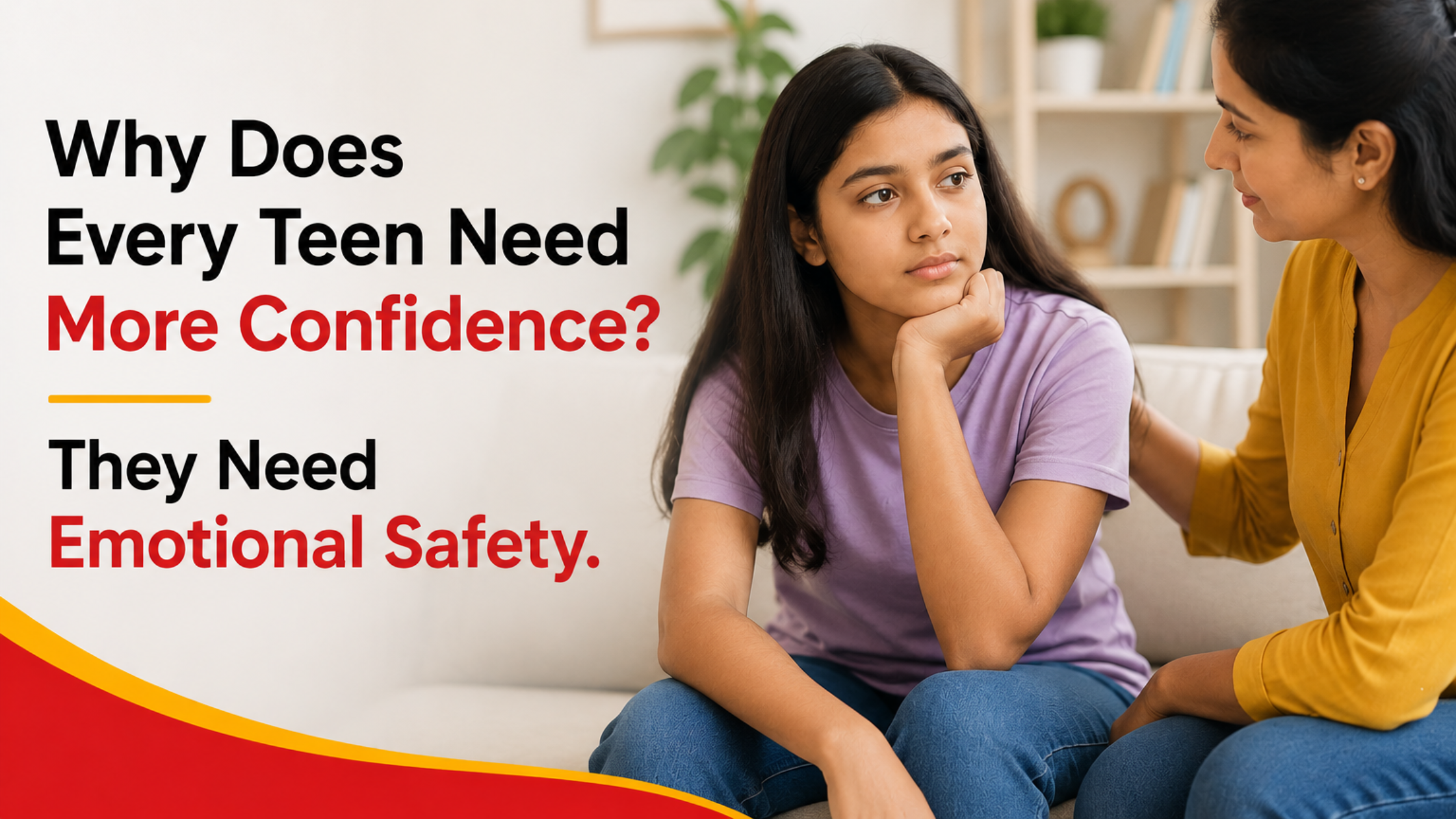
Parents often notice confidence before they notice emotional safety. A teenager hesitates to speak in front of others, doubts their abilities, avoids trying something new, or becomes unusually self-conscious, and the immediate response is often encouragement: “You need to believe in yourself,” “Why are you so nervous?” or “You just need to be more confident.”
The intention behind these words is usually positive. Parents want their teenagers to feel capable, independent, and prepared for the world. But confidence is not always something that can be created simply by telling a young person to have more of it. Sometimes, what appears to be a confidence problem is actually something deeper: a teenager who does not yet feel emotionally safe enough to make mistakes, express uncertainty, disagree, fail, or simply be themselves without worrying about how others will respond.
This is why emotional safety deserves more attention during adolescence. When teenagers know they can be imperfect without losing acceptance, they become more willing to explore, speak up, take healthy risks, and recover from setbacks. In many cases, confidence is not where the work needs to begin. It is what begins to grow once emotional safety is already there.
What Does Emotional Safety Look Like for a Teenager?
Emotional safety does not mean protecting teenagers from every disappointment or agreeing with everything they say. Nor does it mean removing boundaries, expectations, or consequences. It means creating relationships in which teenagers know that difficult emotions, mistakes, and disagreements will not threaten their sense of belonging.
A teenager feels emotionally safe when they can admit, “I messed up,” without immediately expecting humiliation. They can say, “I don't know what I want,” without feeling that they have disappointed everyone. They can disagree respectfully with a parent without fearing that the disagreement itself will damage the relationship. They can talk about embarrassment, jealousy, anxiety, friendship problems, academic pressure, or uncertainty without every conversation becoming a lecture.
This matters enormously during adolescence because teenagers are still figuring out who they are. They are experimenting with opinions, friendships, interests, identities, and independence. If every uncertain step is met with criticism, comparison, or immediate correction, they may gradually learn that being vulnerable is risky. Instead of becoming more confident, they become better at hiding the parts of themselves they believe others may not accept.
Why Validation Matters More Than Constant Reassurance

When teenagers doubt themselves, adults often respond with reassurance: “Of course you'll do well,” “There's nothing to worry about,” or “You're overthinking it.” While these statements are meant to comfort, they can sometimes unintentionally dismiss what the teenager is actually feeling.
Validation works differently. It does not require parents to agree with every interpretation their teenager makes. It simply communicates that the emotion itself has been heard.
If a teenager says, “I'm scared I'll embarrass myself during the presentation,” validation might sound like, “I can understand why that feels intimidating, especially when you're presenting in front of your whole class.” Once the teenager feels understood, encouragement becomes much easier to receive.
This distinction is important because emotional safety grows when teenagers discover that uncomfortable feelings are allowed to exist. They do not have to immediately become positive, confident, or fearless in order to be accepted.
Over time, that acceptance teaches something powerful: I can feel uncertain and still handle what comes next.
That is a much stronger foundation for confidence than simply being told to believe in yourself.
Comparison Can Quietly Damage the Safety Parents Are Trying to Build
Comparison is often used as motivation, particularly when parents genuinely believe their teenager is capable of more. Comments such as “Look how confidently your cousin speaks,” “Your friend manages everything so well,” or “Why can't you participate like the other students?” may be intended to encourage improvement.
But teenagers do not always hear the motivational message parents intend.
They may instead hear: Who I am right now isn't good enough.
Repeated comparison can make teenagers increasingly conscious of how they appear to others. Instead of experimenting freely, they begin protecting themselves from situations where they might fall short. They may avoid competitions, presentations, unfamiliar activities, or new friendships—not because they lack ability, but because the emotional cost of failing feels too high.
Confidence develops differently when progress is measured against the teenager's own growth. Recognising that they spoke up when they usually stay quiet, tried something despite being nervous, or recovered after making a mistake reinforces effort without suggesting that their worth depends on outperforming somebody else.
Teenagers Need to Know That Mistakes Are Survivable
One of the strongest signs of emotional safety is the ability to bring a mistake home.
Imagine a teenager receives a poor grade, falls out with a friend, makes an impulsive decision, or fails at something they genuinely cared about. Before telling their parents, they are often already predicting the reaction.
Will they be angry? Will I get a lecture? Will they say they warned me? Will they stop trusting me?
If teenagers repeatedly experience mistakes as moments of shame, they may begin hiding problems until those problems become much harder to manage.
This does not mean parents should remove consequences or pretend poor decisions do not matter. It means separating the behaviour from the relationship. A teenager can be held accountable while still knowing, “We may be disappointed with what happened, but we are here to help you work through it.”
When failure feels survivable, teenagers become more willing to try. They begin taking healthy risks, making independent decisions, and learning from outcomes instead of constantly avoiding situations where they may not succeed.
Ironically, this is where much of genuine confidence comes from not from always succeeding, but from discovering that failure does not destroy you.
Listening Can Build Confidence Without Ever Mentioning Confidence
Parents naturally want to offer solutions because they have more life experience. But teenagers do not always need a solution immediately. Sometimes they need enough space to finish the story.
A teenager describing friendship drama may already know what they should do. A student worried about an exam may not need another study strategy. Someone struggling with self-doubt may not need to hear ten reasons why they are talented.
They may simply need to feel understood before deciding what comes next.
Listening communicates respect. It tells teenagers that their thoughts are worth hearing and that they are capable of participating in their own problem-solving. Instead of immediately saying, “Here's what you should do,” parents can occasionally ask, “What do you think you want to do about it?”
That small change gives teenagers ownership over their decisions while reassuring them that support remains available. Over time, repeatedly making manageable decisions, experiencing consequences, and solving problems builds something much more durable than externally supplied confidence: trust in their own judgment.
Emotional Safety Does Not Make Teenagers Dependent
Some parents worry that being too understanding will make their teenager emotionally dependent or less prepared for a difficult world. In reality, secure relationships often create the opposite effect.
When teenagers know they have a safe base to return to, they are often more willing to explore independently. They can attempt something unfamiliar because failure does not threaten their sense of belonging. They can handle disagreement because they know relationships can survive differences. They can ask for help without interpreting it as weakness.
The goal is therefore not to protect teenagers from every uncomfortable experience. It is to give them enough emotional security to face uncomfortable experiences themselves.
For families where persistent self-doubt, anxiety, withdrawal, emotional difficulties, or communication challenges are beginning to affect everyday life, Child & Adolescent Counselling & Psychotherapy can offer teenagers a confidential and supportive space to understand their emotions while helping families strengthen communication and relationships.
Where parents notice broader concerns involving behaviour, attention, learning, emotional regulation, or development, Psychological Assessments for Children can also provide a clearer understanding of a young person's individual strengths and areas where additional support may be useful.
Confidence Is Often the Outcome, Not the Starting Point
Parents understandably want confident children. They want teenagers who can speak for themselves, handle criticism, make good decisions, recover from setbacks, and walk into adulthood believing they are capable.
But perhaps we sometimes focus too heavily on the visible outcome.
Confidence rarely develops because someone repeatedly tells a teenager to be confident. It develops through hundreds of smaller experiences: being listened to when something matters, being respected during disagreement, being allowed to make age-appropriate decisions, discovering that mistakes can be repaired, and knowing that acceptance does not disappear when performance falls short.
Emotional safety gives teenagers room to discover who they are without constantly worrying about who they are supposed to be.
And from that safety, something important begins to happen naturally. They speak a little more freely. They try things they once avoided. They recover faster when something goes wrong. They become less dependent on other people's approval and increasingly able to trust themselves.
That is confidence but built from the inside rather than demanded from the outside.
FAQs
What is emotional safety for a teenager?
Emotional safety means feeling able to express emotions, make mistakes, disagree, and ask for support without fearing humiliation, rejection, or excessive judgment.
Does validating my teenager mean agreeing with them?
No. Validation means recognising and understanding their emotional experience. Parents can validate feelings while still disagreeing with behaviour or maintaining boundaries.
Can comparison affect a teenager's confidence?
Frequent comparison can make teenagers feel that acceptance depends on matching someone else's achievements or personality, which may increase self-doubt rather than motivation.
How can parents help teenagers become genuinely confident?
Give them opportunities to make decisions, listen without immediately solving every problem, recognise effort and growth, allow manageable mistakes, and maintain a secure relationship through successes and failures.
When should parents consider professional support?
If low self-esteem, anxiety, withdrawal, persistent emotional distress, or communication difficulties begin interfering with school, relationships, or everyday functioning, speaking with a mental health professional can be helpful.