Dreaming of Studying Abroad? How Recent US Policy Changes Are Affecting Indian Students and Their Mental Health
15 Jun 2026
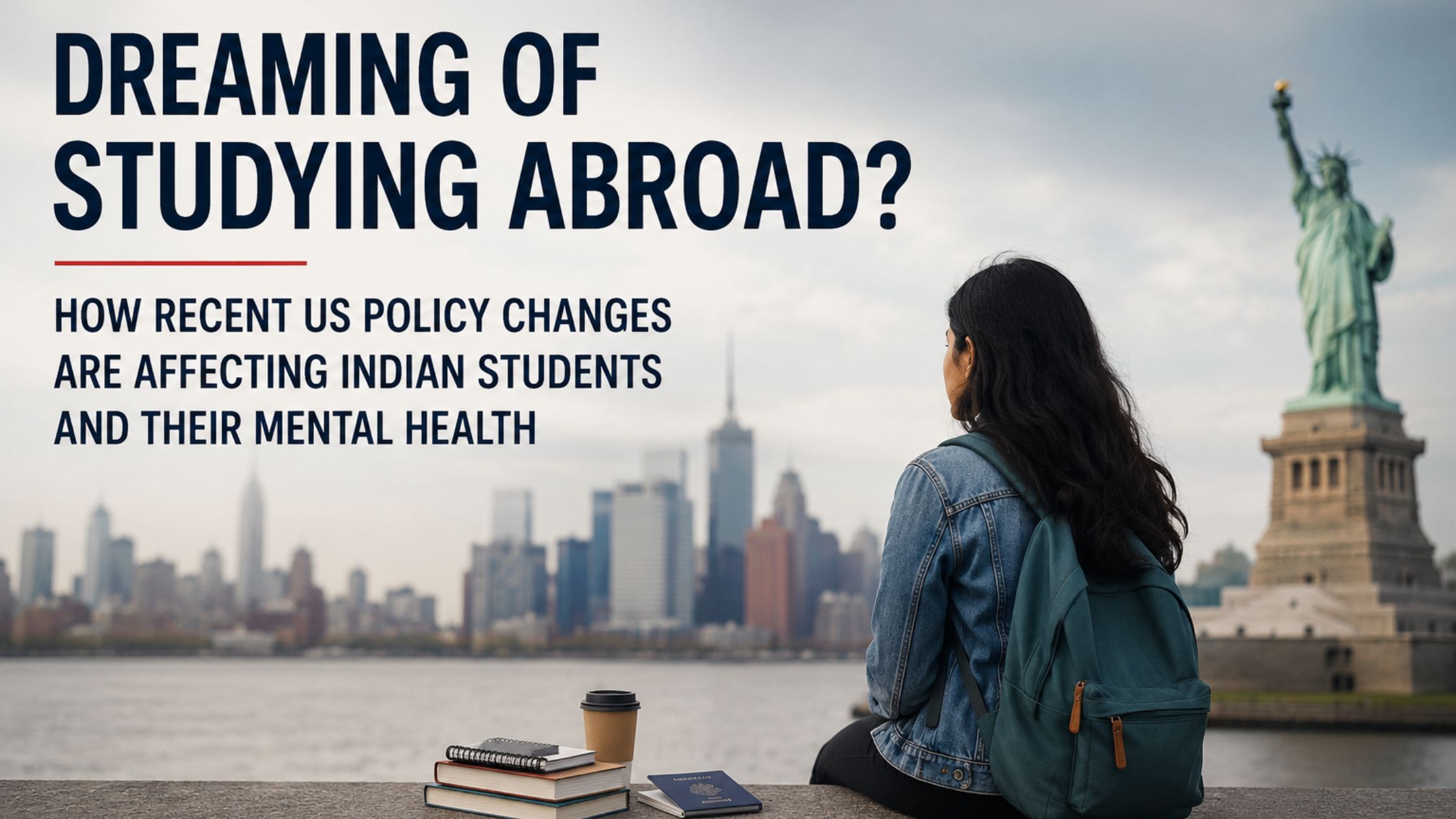
For thousands of Indian students, studying in the United States has never been just about earning a degree. It has often represented something much bigger.
A chance to learn from some of the world's leading institutions. An opportunity to experience a different culture. Access to research, innovation, and global career opportunities. For many families, it also symbolizes years of hard work, sacrifice, and hope for a brighter future.
That dream has motivated students to spend years building academic profiles, preparing for standardized tests, participating in extracurricular activities, and planning every step of their educational journey.
But recently, something has changed. Conversations that once revolved around university rankings, scholarships, and admissions have begun shifting toward visas, immigration policies, work permits, and uncertainty.
Following Donald Trump's return to office and renewed discussions around immigration restrictions and international student policies, many Indian students and parents are finding themselves asking difficult questions about the future.
The concern is not simply about whether students will receive admission offers. The concern is whether the path they have spent years preparing for will remain as accessible, predictable, and secure as it once seemed.
And while these discussions are often framed around education and policy, there is another aspect receiving far less attention:
The impact on mental health. Because uncertainty about the future does not only affect plans. It affects people.
The Dream of Studying Abroad Starts Long Before Applications
One reason these developments feel so emotionally significant is because studying abroad is rarely a spontaneous decision. For most students, it becomes a long-term goal.
The journey often begins years before application season. Students work towards stronger grades, participate in competitions, improve their English proficiency, build extracurricular profiles, and spend countless hours researching universities.
Parents are equally invested. Many families begin financial planning years in advance. Savings are redirected. Educational funds are created. Lifestyle sacrifices are made because parents believe the investment will open doors that previous generations may not have had access to.
Over time, studying abroad stops being just an educational plan. It becomes a shared family aspiration. This is why uncertainty around that aspiration can feel deeply personal.
When students hear news about visa restrictions, immigration reviews, or changing international student policies, they are not merely processing information.
They are questioning a future they have already imagined for themselves.
Why Donald Trump's Policy Discussions Have Triggered New Concerns

Immigration was one of the defining issues during Donald Trump's earlier presidency, and it has once again become a central topic following his return to office.
Discussions around stricter immigration controls, visa scrutiny, employment pathways, and international student monitoring have generated concern among students globally.
It is important to note that American universities continue to welcome international students, and the United States remains one of the most sought-after destinations for higher education.
However, uncertainty often creates fear even before actual changes occur.
Many Indian students are now wondering:
- Will student visa approvals become more difficult?
- Will post-study work opportunities remain stable?
- Could policies change during the course of their degree?
- Will international students face new challenges while pursuing careers in the US?
- Is it safer to consider another country altogether?
What makes these questions difficult is that there are rarely immediate or definitive answers. And when answers are unclear, anxiety often fills the gap.
The Mental Health Cost of Living With Uncertainty
One of the least discussed consequences of these developments is the psychological impact on students.
Most people assume that stress comes from negative outcomes. In reality, uncertainty itself can be incredibly stressful.
Psychologists often describe this as anticipatory anxiety—the emotional strain created by worrying about future possibilities that have not yet happened.
Students may find themselves repeatedly checking news updates, scrolling through online discussions, watching immigration-related videos, and searching for reassurance.
At first, it feels like staying informed. Eventually, it becomes exhausting.
The mind begins running through endless scenarios:
- What if my visa is delayed?
- What if policies change after I receive admission?
- What if my parents invest so much money and things don't work out?
- What if I have to change my plans entirely?
These thoughts can gradually affect concentration, sleep, motivation, and emotional well-being.
And because students are often expected to continue performing academically during this period, many carry these concerns silently.
From the outside, everything appears normal. Internally, however, the uncertainty can feel overwhelming.
The Emotional Burden Parents Often Don't See
Parents naturally focus on practical concerns.
- University choices.
- Finances.
- Scholarships.
- Living expenses.
- Career opportunities.
All of these discussions are necessary. But many students are carrying a different kind of burden.
They know how much their families are investing emotionally and financially. They understand the sacrifices being made.
And this awareness sometimes creates an additional layer of pressure. Students begin feeling responsible not only for their own future but also for the expectations attached to it.
Many worry about disappointing their parents if plans change unexpectedly. Others feel guilty about expressing their anxiety because everyone around them assumes they should be excited.
Some even begin questioning whether they deserve the opportunity in the first place. This emotional weight is rarely visible during conversations about applications and admissions. Yet it is often one of the heaviest things students carry.
When Students Begin Attaching Their Identity to One Outcome
Perhaps one of the most dangerous patterns that develops during this process is identity attachment. A student spends years dreaming about a particular university. A particular country. A particular future.
Slowly, the goal becomes more than an educational aspiration. It becomes part of how they define themselves. Without realizing it, students start believing:
- "If I get there, I will be successful."
- "If I don't, everything will fall apart."
This way of thinking creates enormous pressure. Because suddenly, a university admission is no longer just an opportunity.
It becomes a measure of self-worth. And that is a burden no student should have to carry. The reality is that institutions create opportunities, but they do not determine a person's potential.
Success is not reserved for students who enter one specific university or one specific country.
It belongs to students who continue growing, learning, adapting, and creating value wherever they go.
Is the United States Still Worth Considering?
This is perhaps the most important question many families are asking right now. And the answer is not black and white.
The United States continues to offer some of the world's best universities, strongest research ecosystems, and most influential innovation hubs.
Students continue to gain incredible educational and professional opportunities there. At the same time, it would be unrealistic to ignore that policy discussions and immigration debates can create uncertainty.
The healthiest approach is neither blind optimism nor panic. It is informed flexibility.
Students should continue researching opportunities, preparing strong applications, and exploring universities that align with their goals.
But they should also recognize that higher education is much larger than a single destination.
Why Students Need a Plan B More Than Ever
One of the most valuable lessons emerging from recent developments is the importance of flexibility. For years, many students built their entire future around a single destination.
But today's world demands something different. Students benefit enormously from creating multiple pathways. This does not mean abandoning ambitions. It means protecting them.
Countries such as Canada, Australia, Ireland, Germany, Singapore, and several European nations continue to offer strong educational opportunities. Many Indian institutions are also becoming increasingly competitive on a global level.
Having alternatives does not reduce commitment. It reduces fear. Because when students know there is more than one way to achieve their goals, uncertainty becomes easier to manage.
What Parents Can Do During This Phase
In periods of uncertainty, emotional support becomes just as important as practical guidance. Students do not always need immediate solutions. Sometimes they need reassurance.
Parents can help by creating an environment where concerns can be discussed openly without judgment or panic. Instead of focusing solely on worst-case scenarios, families can discuss possibilities, alternatives, and long-term goals.
The most helpful conversations are often not about what might go wrong. They are about what can still be done regardless of the outcome. When students know they are supported no matter what happens, they often become more resilient in the face of uncertainty.
A Future Bigger Than One Country
Perhaps this moment offers an important reminder for students and parents alike. The original goal was never simply to reach the United States. The goal was growth.
- Learning.
- Exposure.
- Opportunity.
- A meaningful future.
And meaningful futures are rarely dependent on a single country, a single visa, or a single policy.
Donald Trump's policy changes may have introduced uncertainty into the conversation around studying abroad. Future administrations may introduce different changes. Governments, immigration systems, and educational policies will continue evolving.
But a student's potential is not determined by those changes. The qualities that truly shape long-term success—adaptability, curiosity, resilience, self-awareness, and continuous learning—remain valuable regardless of geography.
And perhaps that is the most important thing to remember during uncertain times. The students who thrive in the years ahead will not necessarily be those who faced the least uncertainty. They will be the ones who learned how to move forward despite it.
FAQs
Are Donald Trump's policies affecting Indian students planning to study in the US?
Recent policy discussions around immigration and international students have created uncertainty for many families planning higher education in the US.
Should students stop considering the United States for higher education?
No. The US remains one of the world's leading destinations for education, but students should stay informed and explore alternative options as well.
Can uncertainty about studying abroad affect mental health?
Yes. Ongoing uncertainty can contribute to stress, anxiety, overthinking, and difficulty concentrating.
Why is having a backup plan important today?
Multiple options reduce emotional pressure and help students adapt if circumstances change unexpectedly.
How can parents support students during this period?
Parents can help by listening, offering reassurance, discussing alternatives calmly, and focusing on long-term goals rather than short-term uncertainty.

Ms Samindara Sawant
Ms. Samindara Sawant is a psychologist at Disha Counselling Centre with extensive experience working with children and families.
Related Blogs
No related blogs available.