
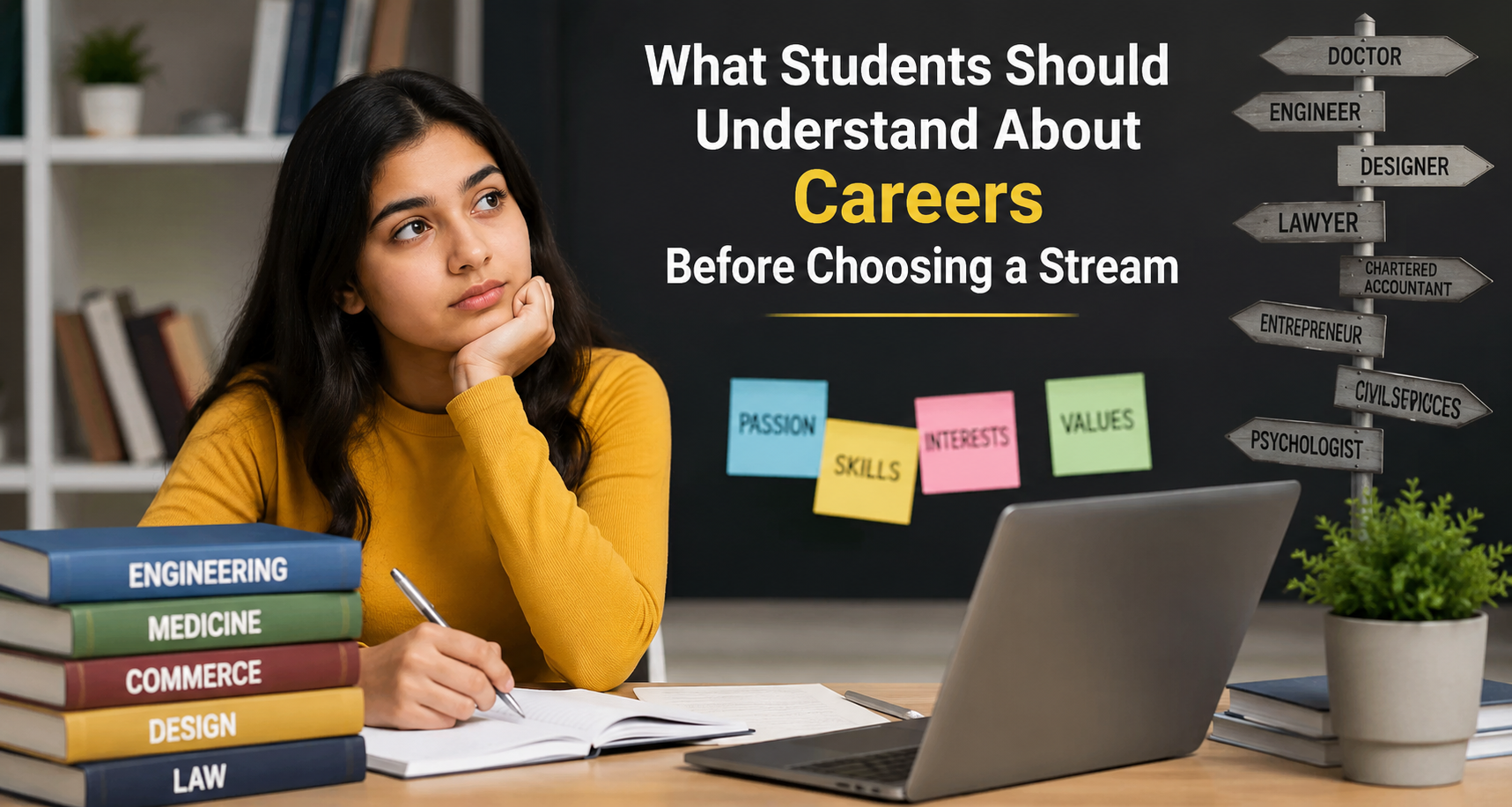
For many students, stream selection becomes the first decision that suddenly feels “serious.”
Until Class 9 or 10, school often feels structured. Subjects are fixed, routines are familiar, and there’s always a next step already decided.
But then one question begins appearing everywhere: “Which stream are you taking?”
Science. Commerce. Arts.
And almost overnight, students begin feeling like they are expected to decide their future before they’ve even fully understood themselves.
Some students choose quickly because they already have a goal in mind. But many others make decisions while feeling uncertain, pressured, or simply afraid of choosing the “wrong” option.
And that is exactly why stream selection deserves deeper thought than most students are usually given.
Because choosing a stream is not just about selecting subjects.
It is often the beginning of how students start seeing themselves, their abilities, and their future possibilities.
The Problem Is That Most Students Know Streams… But Not Careers
Ask most students what science, commerce, or arts includes, and they’ll usually give textbook answers.
Science means engineering or medicine. Commerce means finance or business.
Arts means psychology, media, law, or design. But real careers today are far more dynamic than these simplified categories.
Many students choose streams based on assumptions they have never actually questioned:
- “Science keeps all options open.”
- “Commerce is only for business-minded students.”
- “Arts has fewer opportunities.”
These ideas get repeated so often that students begin treating them like facts. But industries today no longer function in such rigid ways.
Careers are becoming interdisciplinary. Skills matter more. New roles are emerging constantly. And success is no longer limited to a few traditional professions.
Which means students need to understand something important before choosing a stream:
A stream is not a guaranteed future.
It is simply a direction that should align with who the student is becoming.
Choosing a Stream Only Based on Marks Can Create Problems Later

One of the most common mistakes students make is choosing streams purely based on academic scores.
A student scores well in science, so science becomes the automatic choice.
But marks alone do not always reflect:
- interest,
- personality,
- learning style,
- or long-term compatibility with a career path.
A student may be capable of studying physics and chemistry, but still dislike the kind of work certain careers demand later.
Similarly, another student may score average marks but possess exceptional communication, creativity, or analytical thinking that aligns strongly with completely different career paths.
This is why stream decisions made only through marks often create confusion later.
Because capability and compatibility are not always the same thing.
Students Need to Understand Themselves Before They Understand Careers
Before choosing subjects, students should ideally understand:
- how they naturally think,
- what kind of work excites them,
- what environments drain them,
- and what strengths consistently appear in their behavior.
But most students are never really guided through this process.
Instead, they are often asked: “Which stream has more scope?”
when the more useful question might actually be: “Which stream fits this student’s strengths and personality better?”
That shift changes everything.
Because students who choose paths aligned with their natural abilities often feel more engaged, more motivated, and emotionally healthier over time.
Every Stream Has Opportunities — But Not Every Stream Fits Every Student
This is something students and parents both need to understand deeply. No stream is “superior” in absolute terms.
Science is not automatically better than commerce. Commerce is not automatically safer than arts.
Every stream contains careers with:
- strong growth,
- financial stability,
- future opportunities,
- and meaningful work.
But different streams demand different ways of thinking and working. Some students enjoy logical problem-solving and technical systems. Others naturally connect more with people, creativity, business thinking, communication, or social understanding.
And when students choose streams that genuinely align with how they function naturally, career growth often becomes far more sustainable.
The World Students Are Entering Has Changed Dramatically
A decade ago, career paths felt more predictable. Today, entirely new industries exist that were barely discussed earlier.
Students now build careers in:
- UX/UI design,
- digital marketing,
- psychology,
- data science,
- content creation,
- entrepreneurship,
- sustainability,
- and many other evolving fields.
This means stream selection today should not happen through outdated assumptions. Students need exposure to the real world of careers, not just the limited versions people traditionally discuss at home or school.
This is one reason many families today are exploring career assessments and guidance, so students can make decisions based on deeper self-awareness rather than pressure or trends.
Because choosing a stream without understanding the larger career landscape can often lead to regret later.
Why Early Career Awareness Matters More Than Ever
Many students believe career planning starts after Class 12. But by then, important decisions have already been made.
Stream selection influences:
- subject exposure,
- confidence,
- academic direction,
- and sometimes even how students begin defining their identity.
This does not mean stream decisions are irreversible. Career paths today are flexible in many ways. But thoughtful decisions early on can reduce unnecessary confusion later.
That is why structured approaches like career assessment and subject selection programs for students are becoming increasingly valuable. They help students understand not only what they are academically capable of, but also what kind of future may genuinely suit them. And often, that clarity changes the entire decision-making experience.
How Disha Helps Students Make More Informed Stream Decisions
At Disha Counselling Centre, stream selection is not approached as a simple academic decision.
The process focuses on understanding the student more holistically.
Through psychometric assessments, counselling sessions, and guided exploration, students begin understanding:
- their aptitude,
- interests,
- personality,
- learning preferences,
- and natural strengths.
Instead of choosing streams only through marks, peer influence, or fear, students begin making decisions with greater self-awareness and clarity.
And this often changes the emotional experience of stream selection itself. Because students no longer feel like they are randomly choosing a future. They begin feeling like they are understanding themselves more deeply before making an important decision.
A Thought Students Should Remember Before Choosing a Stream
At sixteen, most students are still discovering who they are. So expecting complete certainty is unrealistic.
The goal of stream selection is not to perfectly predict an entire future. It is to choose a direction that currently feels aligned enough to explore further with confidence.
And that decision becomes much healthier when students stop asking: “Which stream is the best?”
and start asking: “Which stream helps me become more of who I naturally am?”
Because careers are built over years. But self-awareness often becomes the foundation that shapes those years meaningfully.
FAQs
Is stream selection after Class 10 very important?
Yes, because it influences subject exposure and future career pathways, but it should not be treated as a life-ending decision.
Should students choose streams only based on marks?
No. Marks matter, but interests, aptitude, personality, and career alignment matter too.
Is science always the best stream?
Not necessarily. Every stream offers strong career opportunities when aligned with the student’s strengths.
Can students change careers later if they choose the wrong stream?
Yes. Career paths today are more flexible than before, though informed decisions early on can reduce confusion later.
How can career counselling help with stream selection?
Career counselling helps students understand their strengths, interests, and suitable career directions before choosing subjects.