
Why Some Teens Would Rather Quit Than Risk Failing Publicly
14 Sept 2026
Why Some Teens Would Rather Quit Than Risk Failing Publicly
A teenager joins a basketball class and quits after three sessions. Another refuses to participate in a school competition despite being genuinely interested. A student who used to enjoy drawing suddenly stops sharing their work. Someone prepares carefully for an audition but backs out just before their turn.
From an adult's perspective, these situations can look like a lack of commitment.
Why don't they stick with anything? Why are they giving up before they have even tried? Why can't they handle a little failure?
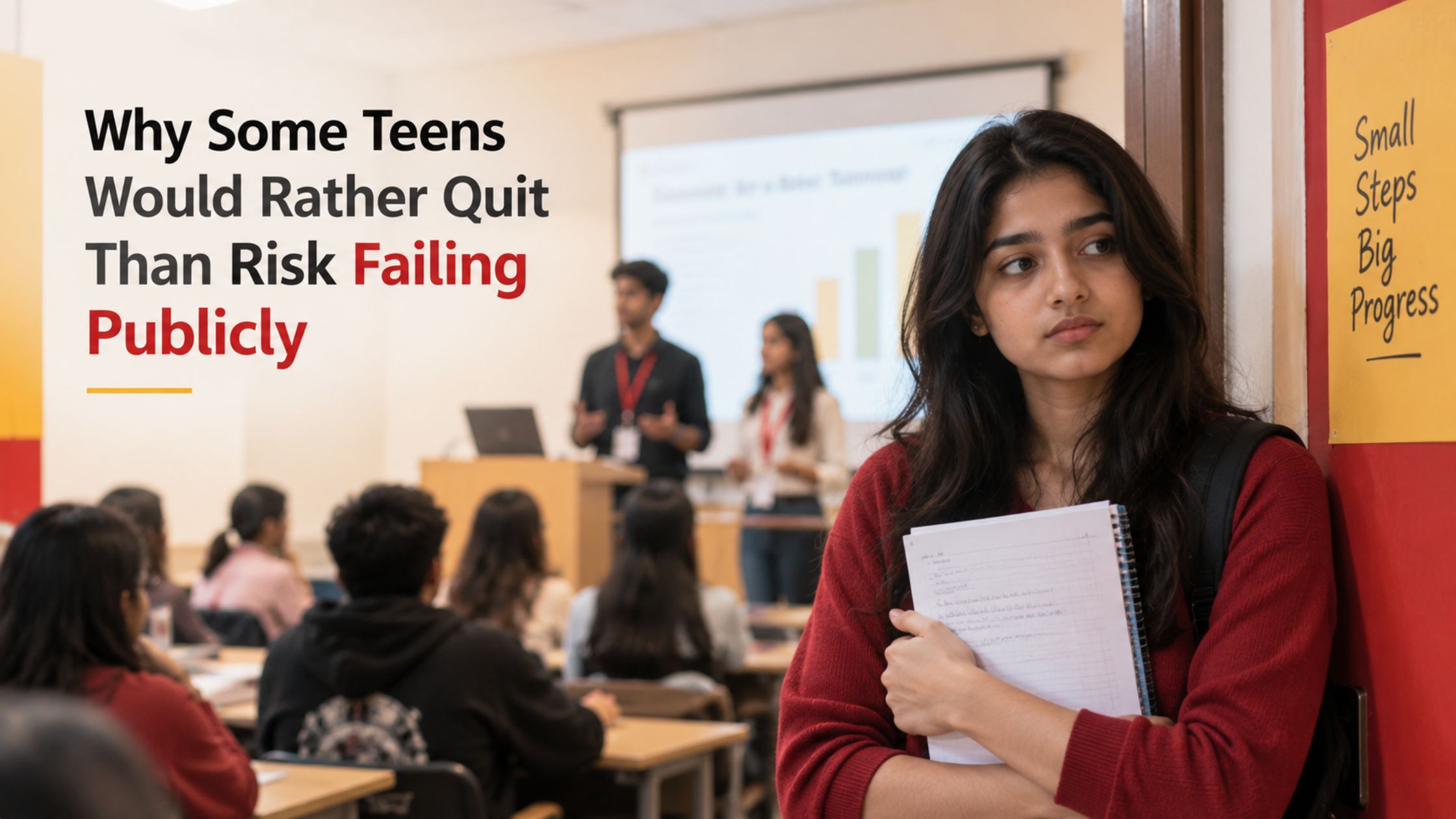
But sometimes the teenager is not afraid of failing itself. They are afraid of being seen failing.
There is an important difference between getting something wrong privately and struggling while classmates, friends, teachers, relatives, followers, or parents are watching. For teenagers growing up in an environment where achievements are highly visible and comparison happens constantly, failure can feel less like an ordinary part of learning and more like a public statement about who they are.
Quitting then becomes strangely attractive. If you stop before the result arrives, you never have to discover—and more importantly, nobody else gets to discover—whether you were actually good enough.
Failure Has Become Surprisingly Visible
Teenagers have always cared about what their peers think. Adolescence naturally brings increased awareness of social acceptance, belonging, and reputation.
What has changed is how visible performance has become.
Marks may be discussed in class groups. Competition results appear on school social pages. College acceptances are announced online. Sports victories become photographs. Certificates are posted. Creative work is measured through likes and views. Even hobbies that once happened quietly in bedrooms can now have audiences.
Young people therefore see an enormous amount of other people's achievements.
What they see much less frequently are the twenty unsuccessful attempts that came before it.
A teenager scrolling through these outcomes can easily develop a distorted picture of competence. Everyone else appears to be succeeding while their own mistakes happen in full detail.
This doesn't necessarily make teenagers unwilling to work hard. It can make them increasingly careful about choosing situations where their competence might be exposed.
“I Don't Care” Can Sometimes Mean “I Care Too Much”

One of the most confusing behaviours for parents is when a teenager suddenly becomes dismissive about something that previously mattered to them.
They wanted to enter the competition, but now it is “stupid.” They were excited about learning guitar, but suddenly it was “boring.”
They wanted a particular college, but after becoming uncertain about their chances, they insisted they “never really wanted to go there anyway.”
Sometimes interests genuinely change. But occasionally, indifference becomes emotional protection. If something doesn't matter, failing at it cannot hurt as much.
A teenager may prefer others to think they did not try rather than watch them try seriously and still fall short. Saying “I could have done it if I actually tried” preserves possibility. Giving everything and discovering that someone else was still better feels much more exposing.
This is why simply telling teenagers to “try harder” can miss what is actually happening. Before discussing effort, parents may need to understand what the teenager believes failure would mean about them.
Comparison Changes the Meaning of Being a Beginner
Being bad at something is an unavoidable part of learning it.
The first drawing may look terrible. The first speech may be awkward. The first attempt at coding may barely work. Someone learning a sport will miss shots, forget techniques, and lose against more experienced players.
Adults understand this intellectually, yet teenagers often experience being a beginner socially.
They are not simply thinking, I'm still learning. They may be thinking, Everyone can see that I'm bad at this.
Comparison makes this particularly difficult because teenagers rarely compare themselves only with other beginners. They compare their first attempts with classmates who have practised for years, creators showing polished work online, or the strongest performer in the room.
The result can be an impossible standard: If I'm not naturally good at this quickly, perhaps it isn't for me.
When teenagers avoid beginnerhood, however, they lose more than one activity. They gradually reduce the number of situations in which they are willing to experiment.
And experimentation is how interests, abilities, and confidence are discovered in the first place.
Parental Expectations Can Raise the Emotional Price of Failure
Parents do not have to explicitly demand perfection for teenagers to feel pressure. Sometimes expectations are communicated through smaller reactions.
A disappointing result leads to a long discussion about what went wrong. A successful result is immediately followed by, “What did the topper get?” A teenager who leaves an activity hears, “But we spent so much money on those classes.” A setback is met with reminders about how much potential they have.
None of these comments necessarily comes from a harmful intention. Parents may simply be encouraging responsibility and wanting their child to make the most of opportunities.
But teenagers can interpret repeated reactions differently: My failures affect how people see me.
This becomes particularly complicated for teenagers who are already known within the family as “the intelligent one,” “the talented one,” or “the child who always does well.” Success may no longer feel like something they achieve. It becomes something they are expected to maintain.
Failure then threatens more than a result. It threatens an identity.
Parents can lower that emotional price by becoming curious about unsuccessful experiences instead of immediately evaluating them. “What do you think happened?” creates a very different conversation from “How could this happen?”
The first makes room for learning. The second can make the teenager feel as though they are standing trial.
Social Media Shows the Result, Not the Awkward Middle
A teenager might see someone their age launch a business, perform brilliantly on stage, get into an impressive university, transform their fitness, create beautiful artwork, or become exceptionally skilled at something.
What rarely fits into the post is the ordinary middle.
The rejected applications. The embarrassing first attempt. The months when nobody paid attention. The lessons that went badly. The videos that received almost no views. The competitions they lost. The moments when they considered quitting.
When teenagers repeatedly consume finished outcomes without witnessing the process behind them, competence can begin to look effortless.
Their own learning, meanwhile, feels messy.
This creates an unfair comparison: somebody else's edited result against their own unedited process.
Parents cannot remove that environment, but they can help teenagers question what they are seeing. Instead of dismissing social media altogether, conversations can focus on what might exist outside the frame.
How long do you think they practised before becoming that good? How many attempts probably didn't make it online?
That small shift moves attention from talent towards process.
Quitting Is Not Always the Problem
It is important not to swing too far in the opposite direction and treat perseverance as automatically virtuous. Teenagers should be allowed to quit some things.
An activity may genuinely no longer interest them. A course may not suit them. A goal chosen at fourteen may feel completely wrong at sixteen. Continuing something purely because “quitters never win” can teach teenagers to remain committed to decisions that no longer make sense.
The more useful question is not simply, Are you quitting? It is, Why do you want to quit?
There is a difference between “I tried this and discovered I don't enjoy it” and “I still want this, but I'm terrified I'll embarrass myself.”
Parents can explore that difference without forcing an outcome. Asking what would happen if nobody else knew the result can sometimes reveal a lot. Would the teenager still want to stop if the attempt were completely private?
If the answer changes, embarrassment—not lack of interest—may be playing a larger role than it first appeared.
Resilience Is Built by Surviving Small Failures
Parents understandably want resilient teenagers, but resilience cannot develop entirely through advice about resilience.
Young people need experiences of getting things wrong and discovering that life continues.
They need to forget a line during a presentation and realise the class moves on. Lose a match and return to practice. Receive a disappointing mark and figure out what to change. Submit something imperfect. Try a hobby they are terrible at. Apply for something without knowing whether they will be selected.
These experiences teach a lesson reassurance alone cannot provide: I can survive being unsuccessful.
Parents can support this process by making failure discussable without making it dramatic. Share ordinary examples of things that did not work out in your own life without immediately turning them into inspirational success stories. Let some disappointments simply be disappointing.
Teenagers do not need every failure converted into “everything happens for a reason.”
Sometimes they need to hear, “That must feel awful. What do you want to do next?”
That question leaves the setback where it belongs—in one moment rather than across the teenager's entire identity.
Sometimes Fear of Failure Begins Affecting Bigger Decisions
Avoidance becomes more concerning when teenagers increasingly organise their lives around situations where success feels guaranteed.
They may choose easier subjects despite genuine interest elsewhere, avoid competitions, refuse leadership opportunities, procrastinate until poor performance can be blamed on lack of preparation, or become extremely distressed by anything less than an excellent result.
Fear of embarrassment can even influence career decisions. A teenager may reject an interesting pathway because they are uncertain whether they will succeed, while choosing something familiar simply because it feels safer.
This is one reason thoughtful career assessment and guidance can be valuable during adolescence. Exploring aptitude, interests, strengths, and possible pathways can shift career conversations away from proving oneself against peers and towards understanding what may genuinely suit the individual.
The goal should not be to find a future in which failure is impossible. No such future exists. It is to help teenagers make decisions that are not controlled entirely by the fear of looking unsuccessful.
Home Can Be the Place Where Performance Stops
Teenagers already encounter plenty of environments where they are evaluated. Schools give marks. Competitions give rankings. Entrance examinations give scores. Social platforms give likes. Peer groups create their own forms of approval.
Home does not need to become another scoreboard.
That does not mean removing expectations or celebrating every unfinished commitment. Teenagers still need accountability. But accountability works better when it is separated from worth.
A disappointing mark can be discussed without becoming a judgment about intelligence. Losing a competition does not require immediate comparison with the winner. Changing an activity does not automatically mean someone lacks discipline.
Most importantly, teenagers should know that bringing home a failure will not change the emotional security of the relationship.
For young people whose fear of judgment, perfectionism, anxiety, or avoidance has begun restricting school, friendships, activities, or everyday life, support for adolescent anxiety and self-esteem can provide a space to explore why mistakes feel so threatening and develop healthier ways of responding to them.
Because sometimes the teenager who appears unwilling to try is actually spending enormous amounts of energy making sure nobody ever sees them struggle.
The Goal Isn't to Raise a Teenager Who Never Quits
It is tempting to think resilience means raising a teenager who always keeps going.
But that isn't quite the goal.
A resilient teenager can decide something isn't right for them and leave it. They can also recognise when fear is trying to make that decision on their behalf.
They can attempt something without needing certainty that they will succeed. They can be inexperienced without feeling ashamed. They can watch someone else perform better without concluding that they have no ability. They can fail publicly, feel embarrassed, and eventually try again.
Perhaps one of the greatest freedoms parents can give teenagers is permission to be visibly unfinished.
To not know yet. To not be naturally brilliant at the beginning. To produce work that needs improvement. To lose sometimes. To change direction.
And to discover that none of those experiences makes them less worthy of being respected, supported, or loved.
Because the teenager who learns that failure can be survived does not become fearless.
They become much less afraid of finding out what they might be capable of.
FAQs
Why does my teenager give up when something becomes difficult?
There can be many reasons, including changing interests, frustration, perfectionism, comparison, anxiety, or fear of embarrassment. Understanding what quitting protects them from can be more useful than immediately assuming they lack persistence.
Can perfectionism make teenagers avoid trying?
Yes. If teenagers believe only excellent performance is acceptable, avoiding an activity can feel emotionally safer than attempting it and risking an imperfect result.
Should parents encourage teenagers to finish everything they start?
Not necessarily. Learning when to persist and when to change direction are both important skills. Parents can help teenagers distinguish genuine loss of interest from avoidance driven primarily by fear.
How can parents make failure feel safer?
Respond to setbacks with curiosity before criticism, avoid unnecessary comparison, separate performance from personal worth, and give teenagers opportunities to make manageable mistakes and recover from them.
When might fear of failure need additional support?
If fear of mistakes or judgment is consistently preventing a teenager from participating in school, friendships, activities, decisions, or opportunities they genuinely want, speaking with a mental health professional may be helpful.

Ms Samindara Sawant
Ms. Samindara Sawant is a psychologist at Disha Counselling Centre with extensive experience working with children and families.
Related Blogs
No related blogs available.